Road Trip in the 'Land of Abundance' Part 1: The Enchanting Fairyland on Earth—Jiuzhaigou Scenic Area in Aba Prefecture, Sichuan
Jiuzhaigou Scenic Area, the only place in China to hold both the titles of 'World Natural Heritage' and 'World Biosphere Reserve', has long been a sacred destination in my heart. On October 23, 2021, I made an appointment with friends to drive to the Aba Tibetan and Qiang Autonomous Prefecture in Sichuan.
On the night of the 23rd, we checked into the Vienna Hotel in Xinyang, Henan. Across from the hotel, there is a restaurant called 'Good Place Private Kitchen'. When we traveled through Xinyang, Henan in July on a trip to Gannan, Gansu, we had dinner there and their South Bay fish was delicious. This time, the restaurant happened to have a banquet, and the quality of the dishes had declined.
On the night of the 24th, we checked into the Vienna Hotel in Hanzhong, Shaanxi. Not far from the hotel, on Wangjiang Road, 80 meters north of the TV tower, there is a 'Northeast Countryside Iron Pot Stew' fish restaurant run by northeasterners. Northeasterners are known for their love of stewed dishes, and it is said that iron pot stewed dishes taste great, with both soup and vegetables, and can also supplement iron. We ordered their three-flavor fish (salmon, green carp, and Huaitou fish) set meal.
At 7 pm on the 25th, we successfully arrived at the 'Jiuzhaigou Celebrity Hotel' in Zhangzha Town, Jiuzhaigou Scenic Area, Aba Prefecture, Sichuan.
The next morning after breakfast at 7 am, we drove for 5 minutes to reach the Jiuzhaigou Scenic Area parking lot. Along the walking path, the brilliant colors of autumn came rushing at us, with clouds and mist drifting over the colorful forests on the mountains—ha, this was telling me that the most splendid season of Jiuzhaigou is today!
Jiuzhaigou is a large tributary of the Baishui River, which is the upper reaches of the Jialing River of the Yangtze River system. There are nine Tibetan villages within the scenic area (currently only Shuzheng Village, Zechawa Village, and Heye Village are preserved), and because the Tibetans of these nine villages have lived here for generations, it is named 'Jiuzhaigou' (Nine Village Valley).
The main valley of Jiuzhaigou is in a 'Y' shape, consisting of three main valleys: Rizegou, Zechawagou, and Shuzhenggou, with a total length of over 50 kilometers. The terrain here is higher in the south and lower in the north, with deep valleys and large height differences. It belongs to a transitional zone between the Qinghai-Tibet Plateau and the Sichuan Basin, so geological movements are very strong, resulting in diverse landforms.
Rizegou is on the right branch of the 'Y'-shaped layout of Jiuzhaigou Scenic Area, stretching 18 kilometers from Nuorilang Waterfall to the Primeval Forest. The section between Nuorilang Waterfall and Arrow Bamboo Lake is the essence of the Jiuzhaigou scenic route, incredibly beautiful and ever-changing.
Jiuzhaigou is known as the 'King of Water Scenery', so after entering the scenic area, we took a sightseeing bus directly to Arrow Bamboo Lake.
As soon as we got off, the air was filled with mist and frost, a layer of ice and snow on the wooden boardwalk, and a coating of frost on the spruce trees ahead.
In the light blue lake, unknown trees grew, showing golden colors; the nearby fir trees looked somewhat 'thin' but still stood energetically.
We strolled along the wooden boardwalk around Arrow Bamboo Lake, surrounded by the colors of late autumn and the charm of the first snow.
Arrow bamboo is the favorite food of giant pandas, and the lake shore is widely covered with arrow bamboo, which is the biggest feature of Arrow Bamboo Lake, hence its name.
Arrow Bamboo Lake is at an altitude of 2629 meters, with an area of 151,000 square meters and a water volume of 930,000 cubic meters. The mirror-like lake surface reflects illusory snow-capped mountains, and the straight, tall spruces by the lake look as if they are growing in the water.
The lake surface of Arrow Bamboo Lake is wide and long, with blue-green water and clear reflections, making it hard to tell whether the mountains (trees) are entering the water or the water is soaking the mountains (trees).
It is said that Zhang Yimou's movie 'Hero' also had scenes of swordsmen Can Jian and Nameless dueling here, making it famous.
The water from Arrow Bamboo Lake flows into the forest, is divided into many streams by dams formed by collapses, and falls along the dams, forming Arrow Bamboo Lake Waterfall.
Arrow Bamboo Lake Waterfall is 150 meters wide, with a drop of only 2-5 meters, and the waterfall body is split in two. The waterfall and the shallow beach are intertwined, layer upon layer.
The blue lake, white waterfall, and golden branches create a colorful wonderland where movement coexists with stillness.
We followed the wooden boardwalk next to Arrow Bamboo Lake downhill to Panda Lake. On both sides of the boardwalk, the sound of gurgling water accompanied us all the way—a veritable 'water forest'.
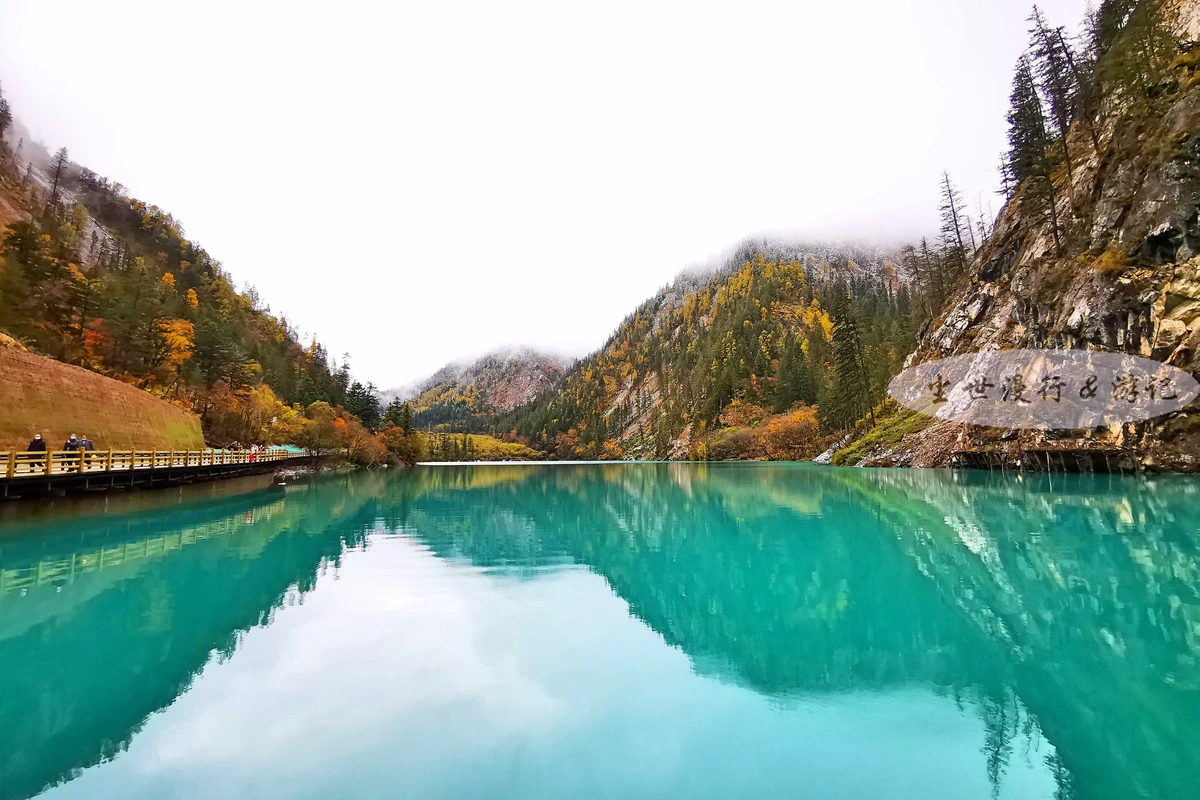
After about 10 minutes downhill, a Tiffany-blue lake suddenly appeared before us—Panda Lake had arrived!
Giant pandas are considered auspicious and are deeply loved by the Tibetans of Jiuzhaigou. It is said that the giant pandas in Jiuzhaigou love to come here to roam, drink, and forage, so this lake is called Panda Lake.
Panda Lake is at an altitude of 2574 meters, with an area of 108,000 square meters and a water volume of 1.8 million cubic meters. It is a glacial barrier lake. The rock walls by the lake have unique textures.
The water of Panda Lake is clear, the peaks stand quietly, the reflections are sharp, and the layered forests on the shore create a dreamy scene of shimmering waves and mountain shadows.
A constantly changing enchanting picture—this second is absolutely different from the last, and there are never two identical pictures—that is Panda Lake.
A gentle breeze stirred layers of blue-green ripples on Panda Lake, swallowing the mountain and tree shadows for a moment...
Following the observation deck on the north side of Panda Lake to the end, and down a steep staircase, we saw a rushing waterfall cascading straight into the valley bottom. Midway, this torrent was intercepted into several sections by protruding rock walls and boulders below the cliff. (No observation deck was seen here, making photography difficult, possibly related to the 2017 Jiuzhaigou earthquake.)
On the night of August 8, 2017, a magnitude 7.0 earthquake struck Jiuzhaigou County, Aba Prefecture, Sichuan, destroying some famous scenic spots and severely damaging infrastructure. On September 27, 2019, the Jiuzhaigou Scenic Area reopened to 85% of its pre-earthquake area. On September 28 this year, the scenic area fully reopened, meaning that attractions above Five Flower Lake, such as Panda Lake, Arrow Bamboo Lake, Swan Lake, and the Primeval Forest, are once again meeting visitors.
We wanted to go around to 'Tiger Mouth' to see the panoramic view of Five Flower Lake, but the staff told us that Tiger Mouth was too dangerous and had been closed. So we went through a tunnel and took a sightseeing bus to Five Flower Lake.
As soon as we got off, a 'colorful screen' dazzled us—the most beautiful autumn of Jiuzhaigou appeared before our eyes.
Coming from afar, what met our eyes were the clear layers of green, bright yellow, orange-red, dark green... and some indescribable colors forming a patchwork of graceful reflections in the embrace of Five Flower Lake. They intermingled without chaos, complemented without encroaching, adorned without crowding—a feast for the eyes, just right.
Five Flower Lake is at an altitude of 2462 meters, 450 meters long, 313 meters wide, and 9 meters deep. It is a barrier lake formed by landslides and mudslides blocking the original glacial valley, known as 'a unique wonder of Jiuzhaigou' and 'the essence of Jiuzhaigou'.
Beneath the clear, colorful surface of Five Flower Lake, sections of tree trunks are visible. Calcareous deposits and various colorful algae divide the lake into many color patches, exuding a charming allure.
Five Flower Lake is like a peacock displaying its tail, colorful and dazzling, a true fairy tale world, a legendary paradise of color!
A lake blended by nature into a colorful, stunning scene—a magnificent sight that can never be artificially created.
From the bridge at the exit of Five Flower Lake, we followed the wooden boardwalk to 'Peacock River Channel'.
Strolling along Peacock River Channel felt like walking in a painting created with the most intense colors. The surrounding scenery, like peacock feathers, blended the most beautiful blues and greens, reds and yellows in the world.
The river channel meanders, with shrubs and trees on both sides dyed in autumn colors, exceptionally splendid...
Water flows among trees, trees grow in water—like a living scroll painting, intoxicating and enchanting.
Trees naturally fall into the lake, with dead wood half-exposed on the water surface, on which new saplings take root and grow into small trees.
Red birch trees by the boardwalk. Red birch loves light and is cold-resistant, with trunks up to 30 meters tall. In China, it is mainly distributed in Sichuan, Yunnan, Qinghai, Gansu, Hubei, Shaanxi provinces at altitudes of 1000-3400 meters. Red birch wood is hard, finely textured, and beautifully patterned, suitable for furniture or panels. The bark can be used for hats or packaging.
Beyond Peacock River Channel is Jinling Lake (Golden Bell Lake), named for two lakes, one large and one small, closely connected, resembling a copper bell. Jinling Lake is at an altitude of 2455 meters, 16 meters long, and 26 meters deep. It is a barrier lake, with the smaller lake reaching a depth of 103 meters, the deepest of all lakes in Jiuzhaigou.
Legend has it that Zhaiyizhaga, the god of all mountains, once shook a golden bell here to subdue demons and left a pair of golden bells. Later, the bells transformed into two lakes, hence the name.
The two Jinling Lakes are adjacent, with deep blue water, like a pair of blue eyes in the valley, hidden in dense shade.
Pearl Shoal is a relatively wide stone beach among the many lakes of Jiuzhaigou. A bridge crosses the shoal. On the south side of the bridge, the water beach is covered with shrubs. The torrent flows under the bridge, and on the north side's shallow beach, countless rolling, jumping pearls are stirred up.
Pearl Shoal is at an altitude of 2450 meters, with a beach width of 112.3 meters, a length of 189 meters, an average slope of 20 degrees, and a relative height difference of 15 meters. It is a large calcareous tufa deposition platform. This is where the scenes of Tang Monk and his disciples leading horses through water in the TV series 'Journey to the West' were filmed.
The shoal surface is covered with a large amount of algae and scattered water-loving shrubs. The water flows about 100 meters through multiple levels falling into the valley. Due to 'biological karst' action and chemical deposition in the flow, the shoal surface is scale-like and rippled. The clear torrent splashes countless broken waves on it, dazzling under light refraction, like rolling pearls.
Legend has it that long ago, a passing goddess fell in love with a Tibetan youth. The youth gave her a string of pearl necklace, and she gave him a mountain-opening axe. The youth used the axe to dig a canal to divert water. When the heavenly god learned of this, he flew into a rage and sent troops to capture the goddess, tearing off the necklace from her neck. The pearls fell to the ground and turned into the beautiful Pearl Shoal.
The surging water from Pearl Shoal rolls down the cliff edge, forming a wide, crescent-shaped waterfall. The waterfall falls into the valley bottom with a deafening roar, creating a furious torrent. This torrent is the most beautiful in color, swiftest in current, and loudest in sound among all the torrents in Jiuzhaigou.
Pearl Shoal Waterfall is at an altitude of 2443 meters, 21 meters high, 162 meters wide, with a maximum drop of 40 meters. It is a typical combined landscape in Jiuzhaigou. The negative oxygen ion content here is extremely rich, hundreds of times higher than in plain areas, earning it the name 'Natural Oxygen Bar'.
Walking along the boardwalk with the torrent accompanying us, we continued east to the east side of Pearl Shoal. Here the slope is steeper, the beach surface more uneven, the torrent jumps, and the scene is even more spectacular.
In the woods by the boardwalk, there is an 'August 8th Rock', marking a piece of history: At 21:19 on August 8, 2017, a magnitude 7.0 earthquake struck Jiuzhaigou. The earthquake caused a high-altitude collapse, and this boulder rolled from an elevation of 2654 meters down to the river valley, a vertical drop of 272 meters. This rock is 9.2 meters high, 163 cubic meters in volume, and weighs about 522 tons. It is dolomitic limestone, formed in a marine environment 320 million years ago, witnessing the vicissitudes of Jiuzhaigou. The earthquake dislodged the rock from the mountain, causing it to roll and destroy all vegetation along the way, forming a huge gully.
At the end of the boardwalk is a sightseeing bus stop, which takes us to the last attraction of Rizegou, 'Mirror Lake'.
Mirror Lake is at an altitude of 2367 meters, 1155 meters long, 241 meters wide, and 31 meters deep. It is the third largest lake in Jiuzhaigou, named for its calm surface like a mirror. But the best time to view Mirror Lake is before 9 am and after 5 pm.
Although we missed the best photo time, the attractions above Mirror Lake were at the right time! Actually, missing the sunset glow, we could still look forward to a sky full of stars.
After finishing the tour of Rizegou, we took a sightseeing bus to Nuorilang Service Center for lunch at the Nuorilang Restaurant.
Zechawagou is on the left branch of the 'Y'-shaped layout of Jiuzhaigou Scenic Area, stretching nearly 18 kilometers from Nuorilang Service Center to Long Lake. It is the highest altitude route in Jiuzhaigou.
After an hour of lunch and rest, we took a sightseeing bus directly to the end of Zechawagou, 'Long Lake'.
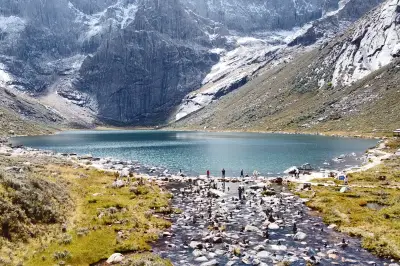
Long Lake is at an altitude of 3101 meters, about 4350 meters long, 300 meters wide, and 90 meters deep, with a storage capacity of 45 million cubic meters. Its shape is an 'S' in plan. It is a glacial barrier lake, a freshwater lake, and the highest, deepest, largest in area and storage capacity of all lakes in Jiuzhaigou.
Jiuzhaigou is one of the best-preserved Quaternary paleoglacial sites in western China, with hanging glaciers, cirque glaciers, and flat-top glacier landforms. The hard ice and carried rocks of glaciers have strong erosive power, carving the valleys into exquisite landforms like excavators. Among them, cirques, U-shaped valleys, glacial erosion lakes, horn peaks, and knife-edge ridges are typical glacial erosion landscapes. Long Lake is a cirque landform.
Long Lake has no outlet; its water source comes from high-altitude snowmelt. Strangely, Long Lake never dries up nor overflows, so Tibetans call it a 'treasure gourd that can never be filled or drained'. Long Lake can be considered the mother of all lakes in Jiuzhaigou. Without an outlet, it relies only on evaporation and underground rivers to discharge water, and these underground rivers are an important source for other lakes.
The dark blue Long Lake is cold and elegant, appearing holy and refined, like a peerless beauty, graceful and pure without a trace of artificiality.
Wandering to the end of the S-bend of Long Lake, the dark blue lake reveals a clear, deep blue-green, exceptionally serene and gentle.
Beside this magnificent scenery, an ancient pine tree stands upright, with all its branches on one side of the trunk, while the other side is bare, like an old man with one arm who has experienced many vicissitudes, guarding this blue-green lake.
Strolling down the wooden boardwalk beside the observation deck, we came to the side of that pool of dark jade. Viewing Long Lake up close, I felt even more that the lake is vast like a sea, the water dark green like jade, white snow gently caressing the colorful forest, clouds and mist hazy and dreamlike...
One kilometer down from Long Lake is Five Color Pond. Five Color Pond is at an altitude of 3010 meters, about 100 meters long, 60 meters wide, and 6.6 meters deep, hidden in a deep valley below the road.
Five Color Pond is the most delicate and exquisite of all the lakes in Jiuzhaigou, famous for its beauty, purity, and transparency. It is said that even when the ground is frozen three feet deep in winter, the pond water remains clear and rippling; throughout the four seasons of rain and drought, the pond water seems neither to increase nor decrease. This is because the pond water is supplied underground from the higher Long Lake, and the underground temperature is constant throughout the year, so the recharge amount is largely stable.
The gravel at the bottom of Five Color Pond and the textures on the rocks are clearly visible. The pond water is vivid blue and emerald green, bright and transparent. The exquisite Five Color Pond is therefore called the 'Eye of Jiuzhaigou'.
The lake grows aquatic plant communities such as water silk, stonewort, and small ferns. These aquatic communities have different chlorophyll contents, showing different colors in the calcium carbonate-rich lake water. Added to the reflections of trees by the lake, in the same lake, some waters are vivid blue, some bays are light green, some water colors are crimson yellow, some springs are pink-blue... endlessly changing, very beautiful.
Shuzhenggou is on the lower branch of the 'Y'-shaped layout of Jiuzhaigou Scenic Area, stretching nearly 14 kilometers from Nuorilang Waterfall to the valley entrance. It has more than 40 lakes, accounting for about 40% of the scenic area.
Nuorilang Waterfall is at an altitude of 2343 meters, 24.5 meters high, and 320 meters wide, making it the widest high-altitude calcareous tufa waterfall in China. 'Nuorilang' means 'male god' in Tibetan, symbolizing grandeur and majesty. This is the filming location for the end of the TV series 'Journey to the West'.
The water of Nuorilang Waterfall comes from the surging waters of more than 40 lakes in Shuzheng Qunhai (Shuzheng Group Lakes). The water pours down from the trees at the top of the waterfall, forming a rare forest waterfall.
The immense water volume, like the Milky Way falling from the sky, is magnificent. The cascading waterfall roars through the valley.
In autumn, the valley slopes are a riot of color, as brilliant as a thick oil painting.
Amid patches of red, yellow, and green leaves, Nuorilang Waterfall divides into countless streams, drifting down gracefully, a very charming scene.
The part indicated by the arrow below is where Nuorilang Waterfall collapsed and was severely damaged during the magnitude 7.0 earthquake in Jiuzhaigou County on August 8, 2017.
From the exit of Nuorilang Waterfall, we took a sightseeing bus to Tiger Lake.
Tiger Lake is at an altitude of 2298 meters, 310 meters long, 194 meters wide, and 23 meters deep. It is named because tigers love to drink from this lake.
In late autumn, colorful forests are reflected on the lake-blue surface, and unknown red and green branches by the boardwalk adorn the lake.
Tiger Lake is located above Shuzheng Waterfall. Gazing at the lake-blue water, there is a sense of calm without waves—silence harboring violence, tranquility hiding arrogance?!
Walking along the boardwalk towards the valley entrance, the rumbling sound of water filled our ears.
A lotus-petal-shaped, multi-tiered rounded waterfall appeared before us.
Shuzheng Waterfall is located beside the road in front of Shuzheng Village. It is the smallest of the four major waterfalls in Jiuzhaigou. At an altitude of 2295 meters, 25 meters high, and 72 meters wide at the top, it is formed by the water of Wuming Hai (Nameless Lake) rushing along the lake embankment, divided into thousands of water jets by the trees in the water, converging at the top of Shuzheng Waterfall.
Upstream of Shuzheng Waterfall, spring water flows freely, passing through trees and rock crevices, divided into hundreds of streams, sometimes smooth, sometimes choked, washing over rocks.
On the terraced lake embankments stand clumps of various shrubs unique to the plateau, rooted in the water bottom, standing proudly in the torrent, enduring the impact of flowing water year after year without falling or rotting roots, graceful and charming, forming a special plant community and a rare natural wonder.
Shuzheng Waterfall is the living water source of Shuzheng Qunhai. The water from the upper lake overflows the embankment, seeps out from the trees, stirring up white splashes, bouncing and dashing in pink-blue and turquoise waters.
Shuzheng Qunhai (Shuzheng Group Lakes) range in altitude from 2187 to 2280 meters. The terrain is formed by debris flow deposits superimposed on the river valley, then further by calcareous tufa deposition, resulting in 19 lakes of various sizes, arranged layer by layer along the valley.
Between the Shuzheng Group Lakes, a long bridge spans the shallow beach. Strolling on the bridge, we leisurely admired the rapids on the shallow beach and the group of lakes.
Across the road from the bridge exit is Shuzheng Village, the most popular Tibetan village in Jiuzhaigou.
Looking down from the boardwalk at the intersection, the 19 lakes are like 19 pieces of blue-green jade inlaid in the deep mountains and valleys, connected by green-yellow-purple forests and small silver waterfalls, as if adorning Shuzheng Village with a beautiful gemstone necklace.
The entire group of lakes is well-layered, with pure and natural colors of green with blue; the colorful forests on the mountains complement the blue lakes, creating a colorful fairyland on earth...
Travelogue Directory: 1. Rizegou—The Essence of the Jiuzhaigou Scenic Route; 2. Zechawagou—The Highest Altitude Route in Jiuzhaigou; 3. Shuzhenggou—The Main Valley of Jiuzhaigou, the Gateway to Its Beautiful Scenery
Travel Information: Hotel Index, Strategy Index, Ticket Index, Website Navigation, Travel Index, Cruise Index, Corporate Travel Index, Join Cooperation, Distribution Alliance, Friendship Links, Corporate Gift Card Procurement, Insurance Agent, Agency Cooperation, Hotel Cooperation, Destination and Scenic Area Cooperation, More Join Cooperation, About Ctrip, About Ctrip, Ctrip Hot Topics, Contact Us, Recruitment, User Agreement, Privacy Policy, Business License, Security Center, Ctrip Content Center, Intellectual Property, Trip.com Group Algorithm Disclosure