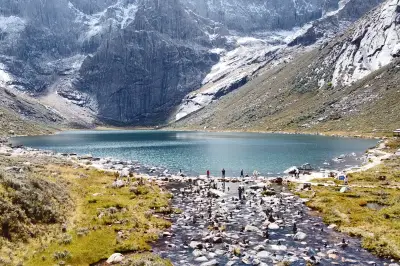
2021 Group Tour to Huanglong and Jiuzhaigou in Sichuan, Visiting Qingmuchuan and Yuanjia Village in Shaanxi
In July 2021, my wife and I joined a group tour. This was a route that passed through Tianshui to visit Gannan, entered Sichuan to see grasslands and the Yellow River; visited Jiuzhaigou and Huanglong, headed north from Guangyuan through Qingmuchuan and Yuanjia Village in Shaanxi, and returned from Xi'an. The entire trip was by coach.
The full itinerary was as follows:
D1: Took a coach from the city via Lianhuo Expressway straight to Tianshui. Stayed overnight in Tianshui. D2: Tianshui—Liujiaxia—Bingling Temple—Linxia. Stayed overnight in Linxia.
D3: Linxia—Labrang Monastery—Sangke Grassland—Langmusi. Stayed overnight in Langmusi. D4: Langmusi—Zhagana—Diebu County. Stayed overnight.
D5: Diebu County—Zoige Flower Lake—Tangke Yellow River Nine-Bend First Bay. Stayed overnight in Tangke. D6: Tangke—Waqie Pagoda Forest—Hongyuan Grassland—Chuanzhusi. Stayed overnight.
++——————————————————————————————————————————————++
D7: Chuanzhusi—Huanglong—Songpan Ancient Town—Jiuzhaigou. Stayed overnight.
D8: Spent the entire day in Jiuzhaigou. Still stayed in Jiuzhaigou.
D9: Jiuzhaigou—Qingmuchuan Ancient Town—Guangyuan. Stayed overnight.
D10: Guangyuan—Yuanjia Village in Shaanxi—Xi'an. Stayed overnight.
D11: Xi'an—Return via Lianhuo Expressway.
This was a travel method I had never tried before, taking a coach for over ten days round trip. The scenic spots were arranged with rich variety, and the entire trip was unforgettable.
After returning home, I wrote a travelogue titled "Via Tianshui to Visit Gannan, See Grasslands and Flower Lake, View the First Bay of the Yellow River." It recorded the first six days of the trip, ending at Chuanzhusi. Due to various reasons such as flood control and epidemic prevention, I stopped writing and did not finish it. Now I muster my spirits to complete it and settle a matter on my mind.
On the sixth day of our itinerary, July 17, we departed from Tangke, passed through Waqie Pagoda Forest and Hongyuan Grassland, and arrived at Chuanzhusi Town, Songpan County, Aba Prefecture, Sichuan Province. In Chuanzhusi, we visited the "Lavender Manor" in Paradise Fragrant Valley. We stayed at the Xuri Xiange Hotel that night.
The seventh day of the itinerary was July 18. After breakfast, we took a coach for 39 kilometers to Huanglong Scenic Area. The day's schedule was: visit Huanglong Scenic Area, Songpan Ancient Town, and then head to Jiuzhaigou for accommodation.
Huanglong Scenic Area is currently the only well-preserved plateau wetland in China, covering an area of 700 square kilometers. The scenic area consists of Huanglong Valley, Danyun Gorge, Maoni Valley, Xuebaoding, Xueshan Ridge, Hongxing Rock, Xigou, and other areas. In December 1992, Huanglong was officially inscribed as a natural heritage site on the UNESCO World Heritage List, and in 1997 it was designated by the United Nations as a "Man and Biosphere Reserve."
We could only visit the Huanglong Valley scenic area. This section is about 4.7 kilometers long and 1-2 kilometers wide, with an altitude ranging from 3145 to 3575 meters. The main landscapes are concentrated here, including carbonate calcification deposits and plateau karst collapse lakes, forming various types of travertine landscapes.
Our group pre-booked Huanglong tickets and one-way cable car tickets online. We smoothly entered with our phones and boarded the cable car. Having the internet is really convenient!
We chose to take the cable car up the mountain, walk 2.9 kilometers along the boardwalk to reach the highest point of Huanglong's main scenic area, the "Five-Color Pond"; after visiting, we followed the boardwalk downhill, viewing Huanglong's attractions along the way, and returned to the entrance of Huanglong Scenic Area.
Around 9:30, we got off the cable car and still needed to walk uphill for a while. Because we started walking too fast, many people experienced obvious altitude sickness. So, when first going up the mountain, don't rush; stay steady and adapt to the high altitude.
I borrowed a simplified Huanglong guide map, which was very good. It clearly and concisely outlined the scenic area's tour route.
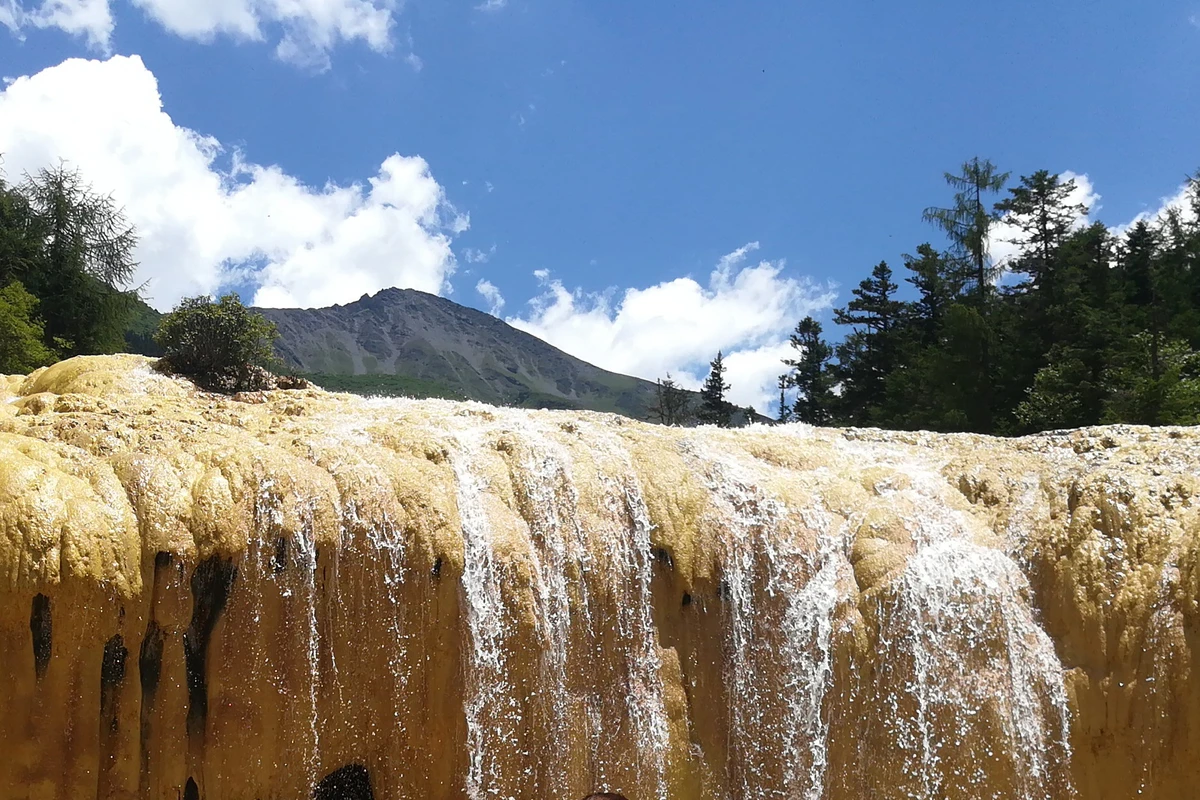
The travertine layers in Huanglong Valley are uneven, with a mainly golden yellow tone, interspersed with milky white, gray, and dark green patches arranged in terraced fields; they display a rich variety of natural flora and fauna. With its peculiar plateau surface karst landscape, it enjoys the reputation of "World Wonder" and "Earthly Fairy Pool."
The Five-Color Pond is the endpoint of the upward route. It took an hour from getting off the cable car to the Five-Color Pond, walking and looking along the way.
Surrounded by mountains, a colorful patch of water—the Five-Color Pond—is nature's finishing touch. Tourists come here to feast their eyes, appreciate the mountains and water, and the unique beauty, then turn back and follow the boardwalk downhill.
The boardwalks in Huanglong are very level, clean, and comfortable. Steps have yellow warning signs, and facilities like visitor services, signage, and tour maps are very user-friendly.
The Huanglong Five-Color Pond is at an altitude of 3576 meters, 4342 meters from the valley entrance. It is the highest point of Huanglong attractions and also the largest, most numerous, and highest-altitude open-air travertine pond group in the world today.
Seeing these extraordinary ponds, I couldn't help but marvel at nature's craftsmanship, creating such a beautiful and uniquely gorgeous fairyland!
The Huanglong Ancient Temple (originally called "Huanglong Back Temple") was built during the Ming Dynasty, mainly following Taoism. The temple is majestic and imposing, built along the mountain. Legend has it that the Yellow Dragon of the East Sea, who helped Yu the Great control floods, retired after achieving merit, cultivated Taoism, became immortal, and became the Yellow Dragon Immortal; his body transformed into ten miles of golden sand, and his scales transformed into thousands of colorful ponds. Later generations, grateful for the Yellow Dragon Immortal's merits, built the Huanglong Temple in commemoration.
After admiring the Five-Color Pond for about an hour, we walked back to the Huanglong Ancient Temple and continued along the boardwalk downhill. We leisurely toured the mountains and waters, walking four kilometers to the exit.
Within Huanglong Valley, there are multiple groups of travertine ponds of various sizes and areas. Some are as large as several acres, majestic; others are as small as basins or plates, delicate and varied in shape. The pond water is brilliantly colored, presenting a dazzling array of colors.
Under the sunlight, cool water flows over the golden travertine, creating ripples and playing a rushing symphony, appearing lively and vivid.
Blue sky, white clouds, green trees, yellow travertine, and the music of sunlight and flowing water.
A small animal by the roadside attracted tourists to stop and watch.
At 2:00 p.m., we reached the exit of Huanglong.
I have been to Huanglong before. Having walked through misty rain in Jiangnan and trekked through the windy desert beyond the Great Wall, seeing Huanglong again still feels beautiful.
This is a photo taken in front of the "Huanglong" stone from early this century. Sigh! Prime years no longer come, a day never has two mornings; time waits for no one.
The mountains are still good; the people are haggard. In a snap of fingers, the scenery is as familiar as ever!
Leaving Huanglong, we drove about 40 kilometers to Songpan Ancient Town.
Songpan Ancient Town, anciently called Songzhou, is located in Jin'an Town, Songpan County, in the northeastern part of Aba Prefecture. It was first built during the Hongwu period of the Ming Dynasty; it has been an important military fortress in northwestern Sichuan since ancient times and also a historically significant post station for "tea-horse trade" among Tibetans, Qiang, Hui, and Han peoples.
It is said that when Princess Wencheng entered Tibet for marriage, Songtsen Gampo welcomed her here; this intermarriage between Han and Tibetans left a lasting beautiful story.
Looking at the city gate of Songpan Ancient Town inscribed with "Songzhou," one feels the town's weight and vicissitudes. In 1992, Songpan Ancient Town was selected as a famous historical and cultural city in Sichuan Province. In 2001, the Songpan Ancient City Wall was designated as a national key cultural relic protection unit.
Modern and ancient streets are filled with flowers and ethnic-style sculptures.
Under the city wall and within the city, different sculptures with different characteristics are full of poetic charm and happy smiles.
The streets and houses in the city combine multiple ethnic elements with distinct styles and features.
The square in the city is spacious and clean.
Songpan Ancient Town stands majestically in northwestern Sichuan, with its history as walls, telling millennia of wonders.
Data shows: As early as the Yuan Dynasty, Kublai Khan led a hundred thousand troops, using Songpan as a base to attack Sichuan. Some of the Hui soldiers who came with the army settled here, transitioning from soldiers to civilians. Later, Hui people from surrounding areas, fleeing war or for business and life, gradually came to Songpan and found a sense of belonging, making the Hui one of the main ethnic groups here.
The streets of the ancient town are also quite ancient, not wide, but the shops and residences are neatly arranged, very distinctive, surprising passing tourists.
Songpan Ancient Town is like a small Hui settlement area. Walking in the ancient town, where the mosque and Hui households cluster, the air is fragrant with fresh flowers, the streets are clean and spacious, peaceful and harmonious.
The swift Min River passes through the ancient town, flowing from east to west, then turning south through the main street and out through the South Gate.
Songpan Ancient Town consists of an inner and outer city, connected by city gates. The city wall is 6.2 kilometers long, 12.5 meters high, built entirely of green bricks, solid and firm. Its thickness reaches 12 meters, arguably the thickest in the country.
We strolled through the ancient town casually, looking around, everything felt novel, taking photos with our phones. In July, it is still bright at 6:00 p.m.; we left Songpan Ancient Town to head to Jiuzhaigou for accommodation.
Along the way, a section of the highway was under repair, slightly congested. We could see a railway being built nearby; it seems in the near future, Huanglong, Jiuzhaigou, and Songpan will no longer be without train service.
From Songpan Ancient Town to Jiuzhaigou, we passed through the highway outside Chuanzhusi Town. Scenery was along the way, and we enjoyed it as we traveled.
At 8:00 p.m., the coach arrived at Jiuzhaigou, and we stayed at the "Jiuzhaigou Holiday Village." We would stay here for two nights.
"Jiuzhaigou Holiday Village" provides a bus to the Jiuzhaigou Scenic Area. Tomorrow we will visit Jiuzhaigou; we can sleep in and take the bus to the scenic area.
On July 19, we spent the entire day in Jiuzhaigou.
Jiuzhaigou—World Natural Heritage, National Key Scenic Spot, National AAAAA Tourist Attraction, National Nature Reserve, National Geopark, World Biosphere Reserve Network, is the first nature reserve in China primarily aimed at protecting natural scenery.
On August 8, 2017, a magnitude 7.0 earthquake struck Jiuzhaigou County, Aba Prefecture, Sichuan, damaging the scenic area. After two years of restoration, part of Jiuzhaigou Scenic Area reopened. (After we left Jiuzhaigou Scenic Area, on September 28, 2021, the entire Jiuzhaigou Scenic Area was fully restored and reopened.)
The landscapes of Jiuzhaigou are mainly distributed in three main valleys: Shuzheng Valley, Rize Valley, and Zechawa Valley, which form a "Y" shape.
The intersection of the three valleys is Nuorilang Central Station, a transfer point for scenic area buses, and also the only place with a restaurant. After visiting each valley, tourists can go to Nuorilang Central Station to transfer to other valleys.
The altitude at the entrance of Jiuzhaigou is about 1900 meters, and the highest point within the valley is Long Lake at 3100 meters. Most tourists will not experience altitude sickness.
We pre-ordered Jiuzhaigou tickets and bus tickets online. Entering with our phones and boarding the bus was smooth.
Look at the "gate" of Jiuzhaigou from the early century; it's different from now, isn't it? An old photo records the past years—taking it out to see, time flies!
Revisiting Jiuzhaigou in July, tourists come and go talking about immortals; my heart is different from tourists, I envy not immortals but the young.
Currently, Jiuzhaigou is still being gradually restored. Parts of Rize Valley have not yet reopened, and the primeval forest cannot be viewed; we could only reach the Five-Flower Lake. The water in Five-Flower Lake has basically recovered. The impact of the August 8 earthquake made us once again feel how powerless humans are in the face of natural disasters. The once magnificent Spark Lake is hard to restore; the water has become a gurgling blue stream flowing into the reeds.
Jiuzhaigou's magical beauty is not innate; it is a stunning work of art forged by nature through glaciers, rockfalls, mudslides, etc. So, we should believe in Jiuzhaigou: old landscapes may disappear and we cannot fully see them, but new landscapes will emerge spectacularly; we wait patiently.
In the past, I had the opportunity to visit Jiuzhaigou twice; unfortunately, my wife had never been, so this time I accompanied her to see Jiuzhaigou. It was a revisit for me.
Jiuzhaigou is named after nine Tibetan villages: Panxin, Gubu, Jianpan, Guwa, Panya'na, Heye, Shuzheng, Heiguokan, and Zechawa. It is renowned both at home and abroad for its "five wonders": 108 emerald lakes (alpine lakes), layered seas, colorful forests, snow-capped mountains, and Tibetan customs, and is known as "Dream Fairyland" and "Fairy Tale World."
Because the area is at a high altitude and there is no sea, locals refer to larger lakes as "Haizi," meaning "son of the sea."
Blue sky—clear lake water—green forest—and you, a girl in splendid attire—ai ye! I love you, Jiuzhaigou, my paradise.
At this moment, it feels as if the melody of Tengger's "Paradise" is echoing; I love you, my home—sung so well.
Strolling on the wooden boardwalk beside the "seas," listening to the endless chirping of birds and the rushing of waterfalls, the colorful and splendid crowds of lakes before our eyes contrast beautifully with the distant peaks.
In the crystal-clear green water, the sturdy forest reflections are picturesque, complementing the underwater trees; water plants, lake water, the sky reflected in the lake, the trees on the opposite shore... Beautiful, pure plateau scenery! Under the sunlight, such rich layers and colors envy and attract people from all over to travel far to appreciate!
Long Lake lies at the end of Zechawa Valley. It is the highest, widest, and deepest sea in Jiuzhaigou, a typical glacial barrier lake. Long Lake has no outlet; its water source comes from high mountain snowmelt. Strangely, Long Lake never dries up nor overflows, so Tibetans call it a "treasure gourd that cannot be filled or drained."
Long Lake is about 1 kilometer from the Five-Color Pond boardwalk. Walking down steps through dense forest, we suddenly discovered a matchless green pond—the smallest, most delicate, and most colorful sea among Jiuzhaigou's many seas. The water of the Five-Color Pond is pure and transparent, like a piece of sparkling jade, set amidst the forest and mountains.
Leaving the Five-Color Pond, we took the scenic area bus to see two more attractions. Getting hungry and tired midway, we found a place to eat and rest. It was comfortable and sentimental. This was my third visit to Jiuzhaigou and Huanglong; the scenic area has really changed a lot. For example, due to the earthquake, Spark Lake and Nuorilang Waterfall were damaged. Nuorilang Waterfall basically recovered after human intervention; Spark Lake disappeared, but at the same time, a new waterfall—Shuanglonghai Waterfall—was formed. Magnificent! Changing nature!
Three visits to Jiuzhaigou and Huanglong, half a lifetime in the snap of a finger. The cycles of seasons, worldly affairs like wind. Flowers can bloom again, but no one can be young again.
After a day's tour in Jiuzhaigou, we were tired. We leisurely and unhurriedly returned to the hotel, like birds returning to their nests. It felt good to have a cozy hotel to rest in.
On July 20, after breakfast at the hotel, we took the coach to leave Jiuzhaigou Scenic Area, beginning our return journey according to the itinerary.
Leaving Jiuzhaigou Scenic Area, the coach headed for Qingmuchuan Ancient Town in Ningqiang County, Shaanxi, 230 kilometers away via Jiuzhaigou County and Wen County.
Early morning, the mountain town of Jiuzhaigou County was very quiet. The county is not large; looking up, you see mountains. The coach drove through the town along the street.
Jiuzhaigou is 70 kilometers from Wen County. There were road construction works along the way, with winding mountain roads. The coach took two hours. Wen County is located at the southernmost tip of Gansu Province, bordering Sichuan and Shaanxi, lying in the Qinba Mountains, and is the southern gateway of Gansu.
Wen County No.1 Middle School is nestled by the mountains and river; the school building was impressive.
The coach meandered along G212, following the Bailong River through rolling hills and high mountain valleys with significant elevation differences. The driver worked hard driving, while the passengers alternately quiet and exclaiming in admiration as they enjoyed the scenery outside the window. This part of the journey was unforgettable.
The Bailong River is the largest river in the Longnan mountain area of Gansu, together with the Qinling Mountains and the Huaihe River, it is an important geographical dividing line in China. The Bailong River leaves Gansu at Zhongmiao Township, Wen County, enters Qingchuan County, and then enters Sichuan Province. It joins the Jialing River at the old town of Zhaohua in Guangyuan. On this trip, we reached Langmusi on July 14 and saw the Bailong River in its infancy; today, on the 20th, we are seeing the rapidly growing Bailong River again.
Along this stretch, the Bailong River babbled joyfully, accompanying us as we watched the mountains, water, and the rolling natural scenery.
The Bikou Hydropower Plant of Datang is located in Bikou Ancient Town, Wen County, Gansu, at the junction of Gansu, Shaanxi, and Sichuan. It is the first large-scale hydropower station in the cascade development of the Bailong River and a hub connecting the southwest and northwest power grids, known as the first pearl on the Bailong River.
When the coach arrived at Qingmuchuan Ancient Town, it was already past noon. The itinerary arranged for lunch and sightseeing here.
Qingmuchuan is located in the northwest corner of Ningqiang County, Hanzhong City, southern Shaanxi, at the junction of Shaanxi, Gansu, and Sichuan provinces. To the west, it connects Qingchuan County, Sichuan; to the north, it borders Wudu County and Kang County, Gansu. It is known as "one foot on three provinces," and is the westernmost town in Shaanxi, 108 kilometers from Ningqiang county town and 197 kilometers from Hanzhong City. It is 80 kilometers from our evening accommodation in Guangyuan, Sichuan.
Qingmuchuan Ancient Town is a national AAAA tourist attraction. The ancient town has excellent natural conditions, good ecological vegetation, and beautiful scenery. It is rich in historical and cultural resources, with traditional old streets, customs, folkways, and traditional living and production tools, all with unique styles. Ancient buildings, cliff inscriptions, ancestral halls, temples, and inscribed stones showcase the town's long history and deep cultural heritage.
The best-preserved building in the ancient town is the Wei Family Compound, built by the well-known gentry Wei Futang during the Republic of China period. With the 2014 hit TV series "A Generation of Heroes," adapted from Ye Guangqin's novel "Qingmuchuan," the original site of Fenglei Town—Qingmuchuan Town in Ningqiang County—gained widespread attention and became a tourist hotspot.
The two large compounds, old and new, built by Wei Futang, look like Beijing's quadrangle courtyards from the outside and remain the most prominent buildings in Qingmuchuan Town.
The Wei Family Compound houses a Ford car. It's hard to imagine how cars were driven and where gasoline came from on the rugged mountain roads of this tri-province border area in those days. If you don't see it, you won't know; the world is truly amazing! History always makes one sigh.
Qingmuchuan Ancient Town has an ancient flavor, but it's not too ancient. The main buildings with some historical significance are mostly from the late Qing Dynasty and the Republic of China period.
Qingmuchuan also has some recently built houses with various styles serving tourists from all directions.
The Jinxi River bends around the ancient town, pulling the old street into an arc, shaped like a lying dragon. The Jinxi River is also a tributary of the Bailong River.
Leaving Qingmuchuan Ancient Town, we headed to Guangyuan City, Sichuan, for accommodation.
Guangyuan City is located in northern Sichuan, historically an important passage into Sichuan. I have visited attractions in Guangyuan such as Jianmen Pass, Zhaohua Old Town, and Mingyue Gorge before. Passing through today, we could take a look at the street scene, rest for a night, and continue tomorrow.
Shortly before 5:00 p.m., we checked into the Magnolia Hotel in Guangyuan. It was still early, so we could stroll around the city center.
From the hotel, we took a high-altitude photo of the street scene. Climbing high and looking far, surrounded by mountains with floating white clouds; the northern gateway of Sichuan, rapidly developing with a new look.
As night fell, we took another photo of the night view from the room. What a beautiful night, captivating the heart—Guangyuan city center at night!
At 8:00 a.m. on July 21, we boarded the coach in Guangyuan and headed north on the Beijing-Kunming Expressway for over 460 kilometers to Yuanjia Village in Liquan County, Shaanxi, and would stay in Xi'an overnight.
Guangyuan's morning was misty, with fog shrouding the river, giving the city a particularly mysterious and peaceful appearance. The two drivers, the tour guide, and the more than 30 tourists on the coach were all exceptionally relaxed—ha ha—almost home.
The interchanges outside Guangyuan were layered and extensive, turning natural barriers into thoroughfares—Difficult roads in Shu? Now, with highways crisscrossing, travel is very convenient.
We took a break at the "Zhongzi Service Area," and after leaving, we would enter Shaanxi Province.
Yuanjia Village belongs to Yanxia Town, Liquan County, Xianyang City, and is a AAAA scenic spot. It is 60 kilometers from Xi'an, about a one-hour drive, and 30 minutes from Xianyang Airport. The village covers an area of 0.4 square kilometers, and the core scenic area is relatively small, but there are many small streets. Although the area is not large, it takes at least three to four hours to explore while eating and wandering.
The Yuanjia Village History Museum is located at the village entrance. The exhibitions inside are divided into historical, entrepreneurial, achievements, and honor sections.
Yuanjia Village is cleverly arranged according to the terrain. The house layout follows the traditional north-south orientation, square and upright. The streets and lanes are also straight and orderly, arranged neatly, but adapted to the terrain, with varying heights and well-organized.
Yogurt has become a star product of Yuanjia Village. Milk from local cows is made into fermented yogurt, priced at 6 yuan per bottle. When opened, a thick layer of yellow cream sits on top, rich and smooth, refreshing and not greasy.
In the Hui Street, various foods are authentic in color, aroma, and taste, clean and original, very appealing.
The snack street gathers almost all the delicacies of Guanzhong. The buildings all use the same blue bricks and gray tiles, same earthy colors and flavors.
The layout of streets and lanes in Yuanjia Village, including traffic flow, air, drainage, and ventilation, relies on the terrain and landforms, making the architectural style and features conform to human, natural, and ecological needs.
Going up from the snack street, you can see the bar street and cafes. Starbucks is also settled in old buildings with blue bricks and gray tiles.
Yuanjia Village has complete organizations like the Party branch, village committee, and residents' committee, having achieved many honors.
Communications are developed now, and information spreads quickly. En route, everyone learned that due to heavy rain in Henan, the Longhai Railway and Lianhuo Expressway Luoyang-Zhengzhou section were interrupted. Those in the tour group who needed to transfer in Zhengzhou immediately decided with the tour guide to leave the group, buying their own tickets to fly home from Xianyang Airport or taking detours from Xi'an to return home.
Transportation is convenient now. Those going to Xianyang Airport hailed a taxi from Yuanjia Village and left. Everyone waved goodbye! Bon voyage!
The coach left Yuanjia Village at 6:00 p.m., and an hour later we checked into a hotel in Xi'an.
On July 22, we were supposed to return home in the afternoon according to plan. Because the roads were interrupted, the tour guide communicated with the home base and discussed with everyone: Safety first, rest a day in Xi'an. Depending on the road recovery situation, we would decide on the return time.
So, those who liked to play went out to explore; those who wanted to rest stayed in bed. We checked our phones, contacted home, worried and assessed the impact of the flooding and the road recovery for tomorrow.
The companions who took flights or trains from Xi'an gradually informed us via WeChat group: they had safely arrived home.
Spring has a hundred flowers, autumn has the moon; summer has cool breezes, winter has snow. If nothing bothers you, it's a good time in the world!
Xi'an has a unique historical and cultural landscape and is one of China's best tourist destinations. I often came to Xi'an for work in the past and witnessed its development. It has been 10 years since I last came to Xi'an; the changes are truly great! It has become an international metropolis with historical and cultural characteristics.
In the morning, we rested at the hotel; in the afternoon, we took a stroll around the hotel vicinity, seeing the city streetscape, parks, flowers, small bridges, flowing water, and green trees. We relaxed and spent this slightly anxious day.
In the evening, the tour guide informed everyone: They had contacted home, and we would depart for home after breakfast tomorrow.
On July 23, we had been away from home for 12 days. Everyone was eager to return. Although we were uncertain about the road ahead, we believed that with everyone's unity and the accompanying coach, the journey home should be smooth. As the saying goes, "There will always be a road at the foot of the mountain."
Xi'an's morning was overcast, with heavy traffic on city roads.
When crossing the Ba Bridge, traffic noticeably decreased.
Goodbye! Xi'an.
On the first day of this trip, I took a few photos of the Yellow River at Fenglingdu from the car. On the return, we saw Fenglingdu again; the river was larger and yellower, feeling even more familiar. Home was closer.
Now, with an extensive highway network and good communications, the driver took the Luoyang Ring Road—Erguang—Zhengzhou-Shaoluo Expressway, avoiding the flood-damaged sections, and we arrived home safely in the afternoon.
When we set out on this trip, the tour guide set up a WeChat group. Along the way, we communicated itinerary information, conveyed notes, and shared photos and videos. It was very convenient and practical. This travelogue uses a few photos posted by group members, and I would like to express my gratitude here.
I sincerely wish everyone has wonderful memories of every trip they take!
Travelogue Table of Contents:
1. Depart from Chuanzhusi, visit Huanglong Scenic Area and Songpan Ancient Town, stay in Jiuzhaigou
1.1 Huanglong Scenic Area
1.2 Songpan Ancient Town
2. Jiuzhaigou Scenic Area
3. Depart from Jiuzhaigou, visit Qingmuchuan Ancient Town, stay in Guangyuan
3.1 Jiuzhaigou to Qingmuchuan
3.2 Qingmuchuan Ancient Town
3.3 Guangyuan City
4. From Guangyuan, Sichuan to Yuanjia Village, Shaanxi
4.1 Yuanjia Village, Shaanxi
4.2 Rest a day in Xi'an
5. Return from Xi'an
Travel Info: Hotel Index, Strategy Index, Ticket Index, Website Navigation, Travel Index, Cruise Index, Corporate Travel Index, Cooperation, Distributor Alliance, Friendship Links, Corporate Gift Card Procurement, Insurance Agency, Agency Cooperation, Hotel Partnership, Destination and Scenic Area Cooperation, More Cooperation. About Ctrip: About Ctrip, Ctrip Hotspots, Contact Us, Careers, User Agreement, Privacy Policy, Business License, Security Center, Ctrip Content Center, Intellectual Property, Trip.com Group Algorithm Disclosure.