Stories on Both Sides of the Qinling Mountains - A Ten-Thousand-Mile Western Loop Journey (1)
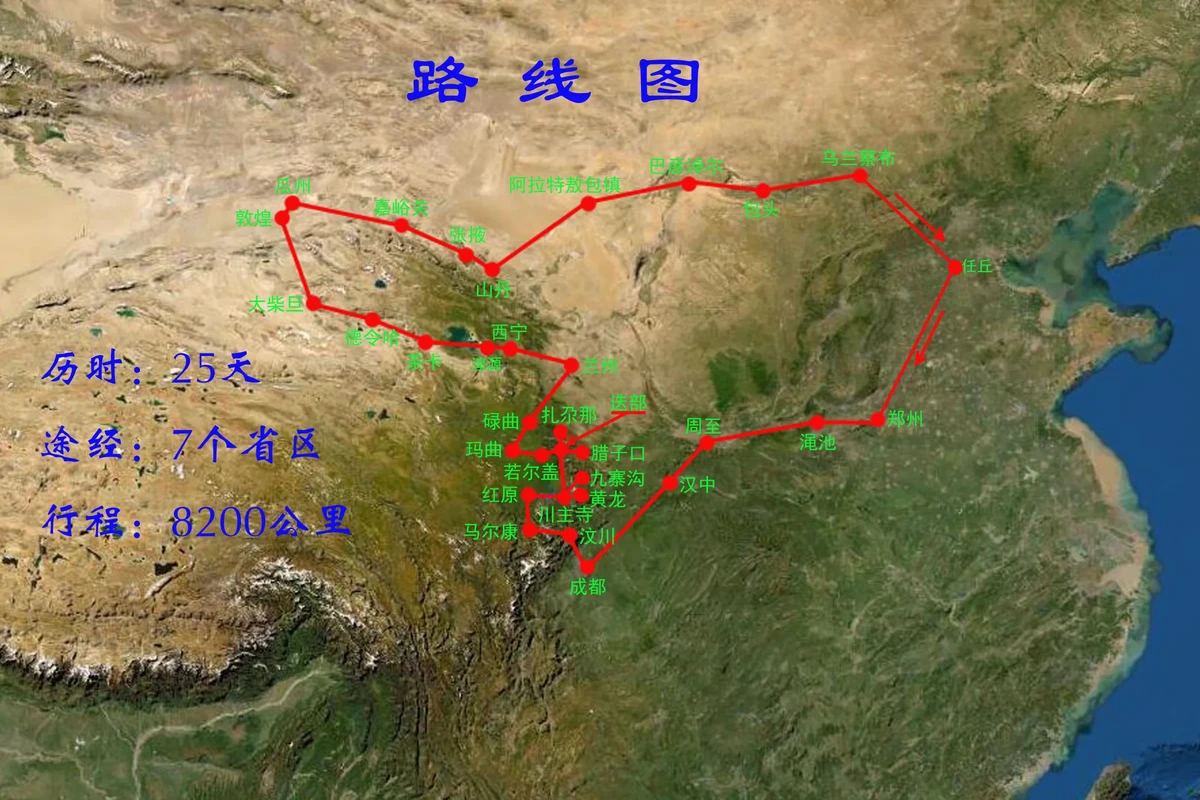
In July 2021, eight old friends from four families spent 25 days traveling through 7 provinces and regions, covering 8,200 kilometers, completing a self-drive tour of the western loop.
Mianchi On July 5th, we departed from Renqiu, drove 740 kilometers along the Daguang, Jinggang'ao, and Lianhuo Expressways, and arrived at Mianchi County, Henan in the afternoon.
Mianchi 1 We checked into Mianchi Hotel, which had good conditions and was reasonably priced.
Mianchi 2 Mianchi has a long history and boasts tourist attractions such as the Yangshao Culture site. This time we didn't arrange a visit, but after dinner we just took a look at the "Ancient Qin-Zhao Alliance Platform".
Mianchi 3 (Alliance Park) The Ancient Qin-Zhao Alliance Platform is located in the Alliance Ecological Park in the southwest of the county town.
Mianchi 4 (Alliance Stele Pavilion) According to the Records of the Grand Historian, during the Warring States period, King Zhaoxiang of Qin proposed a peace alliance with King Huiwen of Zhao at Mianchi. Lin Xiangru accompanied the King of Zhao. During the feast, the King of Qin forced the King of Zhao to play the se and ordered his historian to record it in Qin's history, embarrassing the King of Zhao. Lin Xiangru then insisted that the King of Qin play a fou, and also ordered Zhao's historian to record it in Zhao's history. Qin officials objected and threatened to have Zhao cede 15 cities to congratulate the King of Qin, but Lin Xiangru in turn demanded that Qin cede its capital Xianyang to congratulate the King of Zhao. After a fierce verbal confrontation, the King of Qin gained no advantage and had to reconcile with the King of Zhao. To show friendship, soldiers from both sides piled up soil to bury their weapons, forming the alliance platform.
Mianchi 5 (Alliance Stele) To commemorate this history, a stele pavilion was built on the alliance platform in the Ming Dynasty. It was destroyed and rebuilt several times. The current one was rebuilt in 1985. The platform is 14 meters high, the pavilion is 8 meters high, and the octagonal pavilion houses a stele inscribed with "Ancient Qin-Zhao Alliance Platform".
Qinling On July 6th, we continued westward along the Lianhuo Expressway and arrived at the Qinling Mountains at noon. The Qinling Mountains start from southern Gansu in the west and extend to western Henan in the east. The main section runs across southern Shaanxi. The southern slope has a humid climate and is the source of the Han River, while the northern slope is steep with spectacular scenery. The Qinling Mountains are the dividing line between northern and southern China and are full of stories, making them a highlight of this trip.
Qinling 1 In ancient times, to enter Sichuan from Xi'an, one had to cross the Qinling Mountains to reach Hanzhong first. There were four ancient plank roads from Xi'an to Hanzhong: from east to west, they were the Ziwu Road, Tangluo Road, Baoxie Road, and Chencang Road, each with many historical stories. Our plan was to spend half a day driving south on the Ziwu Road to the watershed and then return; spend a whole day crossing the Qinling Mountains via the most scenic Tangluo Road; and another half day visiting the Longmen Plank Road at the southern end of the Baoxie Road. We gave up the Chencang Road, thus covering three of the four ancient roads.
Ziwu Road The Ziwu Road starts from Ziwu Valley at the northern foot of the Zhongnan Mountains in the Qinling range and ends at Ziwu Town in Xixiang County, Hanzhong, with a total length of 330 kilometers. It is named after passing through Ziwu Valley.
Qinling 2 After the Hongmen Banquet, when Liu Bang went to Hanzhong to take up his post, he sent Zhang Liang to burn the plank road of Ziwu Road. It regained prosperity during the Tianbao period of the Tang Dynasty because Yang Guifei, the imperial consort, loved lychees from Fuzhou, south of the Qinling Mountains, which were her hometown. Relay horses had to rush along the Ziwu Road to deliver them quickly, giving rise to the line "A single red steed brought a smile to the consort's face, yet no one knew it was the lychee that came." Hence it was also called the "Lychee Road". The current G210 National Highway is built on its foundation.
Watershed of Ziwu Road The main checkpoint on Ziwu Road is the watershed, located at the 997 km mark of G210 National Highway. There stands a stone tablet inscribed with "Qinling Mountains", flanked by stone walls carved with "Yangtze River System" and "Yellow River System". South of the tablet is the Yangtze River basin, and north is the Yellow River basin. The watershed is 2,100 meters above sea level, the highest point on G210, but not the highest point of the Qinling Mountains. The northern slope of this section of the Qinling Mountains is relatively steep, so the distance from the watershed to Xi'an is relatively short, only 65 kilometers to the city center. From the Fengyu Valley entrance, there is a 28-kilometer uphill road with a drop of over 1,400 meters in elevation. The scenery is beautiful with mountains and water, but the slopes are steep and the curves are many, so speed must be controlled.
We turned back from the watershed, continued westward for 100 kilometers to reach Zhouzhi County, and checked into the Hanting Hotel.
Zhouzhi 1 (Hotel Room) Zhouzhi is located 80 kilometers west of Xi'an, at the northern end of the Tangluo Road. We chose to stay here mainly for convenience in crossing the Qinling Mountains tomorrow. The historical celebrity of Zhouzhi is Li Yong, also known as Erqu, a philosopher of the late Ming and early Qing dynasties, one of the "Three Great Confucians of the Sea" during the Ming-Qing transition. He left behind 46 volumes of the "Erqu Collection".
Zhouzhi 2 (Statue of Li Yong)
Tangluo Road On July 7th, we crossed the Qinling Mountains along the G108 National Highway built on the foundation of the Tangluo Road, heading towards Hanzhong.
Tangluo Road 1 The Tangluo Road starts from Luoyu in Zhouzhi County in the north and exits the Tangshui River Valley in Yang County in the south, taking one character from each place name to form its name. It is 240 kilometers long and was the shortest and most dangerous among the four plank roads from Chang'an to Hanzhong in the past.
Tangluo Road 2 During the Three Kingdoms period, when Liu Bei established a military base in Hanzhong to campaign against Wei, the Tangluo Road was the preferred route for advances and retreats. It flourished briefly in the Tang Dynasty but was abandoned in the Southern Song Dynasty and never used again.
Tangluo Road 3 Legend has it that during the An Lushan Rebellion, Yang Guifei's death at Maweipo was a substitute. Her real body went south from Maweipo, took the Tangluo Road to Hanzhong, then followed the Han River to the Yangtze River, reached Yangzhou, mingled among brothels, and later went to Japan. Bai Juyi's "Song of Everlasting Sorrow" includes the line "On the dusty ground below Maweipo, no jade face is seen, only an empty grave." The poem was written only 50 years after the rebellion, so he likely had access to real material. Some say they have traced Yang Guifei's footsteps in Japan, visited temples and tombs dedicated to her. Japan has a Senyu-ji temple that still enshrines a Guanyin statue of Yang Guifei, and there have even been Japanese girls who claimed to be her descendants with documents.
Tangluo Road 4 The area along the Tangluo Road is the best ecological environment in the Qinling Mountains. The "Four Treasures" of the Qinling: giant pandas, golden monkeys, crested ibises, and takins, all live here. There are the "Golden Monkey Reserve" in Zhouzhi County, the "Panda Valley" in Foping County, and the "Crested Ibis Reserve" in Yang County. Originally we planned to visit all three reserves, but an accident happened: one car forgot to refuel before departure, and the tank ran dry!
Tangluo Road 5 From Zhouzhi to Foping, there are 120 kilometers of rugged mountains without a gas station. Now we were 50 kilometers away from Zhouzhi, truly in the middle of nowhere. God helps the worthy. At the critical moment, a motorcycle came. We quickly asked for help. The rider turned out to be a repairman from a roadside shop, and he had gasoline at home! We took the motorcycle to fetch a can, solving the problem, but we lost time. By the time we reached the Golden Monkey Reserve, it was already closed. It turned out the reserve was a cooperative project with a university, and the school was on holiday, so there were no students to feed the monkeys, hence it was closed. For the Panda Valley behind, we figured wild ones wouldn't be seen, and captive ones were no different from those in zoos, so we gave up on them and headed straight to Hanzhong.
Tangluo Road 6 The scenery along the Tangluo Road was still beautiful. However, we hadn't expected the Qinling Mountains to be so high, the mountain range so wide, and the roads so winding. But the road surface was smooth and relatively wide. As long as we were careful with the curves and controlled speed, safety was not a problem.
Tangluo Road 7 We had lunch in Foping County.
Foping County Town We arrived in Hanzhong in the afternoon and checked into the Hanting Hotel.
Hanzhong Hanzhong 1
Hanzhong 3 Hanzhong is a famous historical and cultural city, named after the Han River. It is known as the "Land of Abundance" and "Little Jiangnan of the Northwest".
Hanzhong 4 Hanzhong is the birthplace of the Han family. Liu Bang rose to power here, establishing the Han dynasty that lasted over 400 years. The titles Han dynasty, Han people, Han Chinese, Han language, Han culture, etc., have been passed down to this day. Hanzhong is a place full of legendary stories: Xiao He chasing Han Xin under the moonlight, Han Xin's feigned repair of plank roads and secret crossing of Chencang, Liu Bei proclaiming himself King of Hanzhong, Huang Zhong killing Xiahou Yuan at Mount Dingjun, Zhao Yun defeating Cao's army at the Han River, and Zhuge Liang's six expeditions from Qishan, all happened here. Literary figures like Li Bai and Du Fu also left many poems and writings. There are many things to see, but this time we only arranged visits to the Worshiping General Platform and the Ancient Han Platform in the city.
Worshiping General Platform July 8th The Worshiping General Platform is located on the south side of Nanzhong Ring Road in Hanzhong. It is said to have been built by Liu Bang of the Western Han to worship heaven and earth and to appoint Han Xin as general.
Worshiping General Platform 1 The platform consists of two earthen platforms, north and south. The southern platform is over 3 meters high, surrounded by white marble railings, with a statue of Han Xin on top. Below the platform, there are two stone tablets on the east and west sides. The east tablet is inscribed "Worshiping General Platform", and the west tablet is inscribed "Platform for Worshiping Han Xin, General of the Han Dynasty". I'm not sure whether it's "Platform" or "Altar".
Worshiping General Platform 2
Worshiping General Platform 3 On the northern platform, there is a pavilion with a plaque reading "Worshiping General Platform". It has flying eaves and upturned corners, appearing majestic.
Worshiping General Platform 5 Behind the northern platform to the west, there is an exhibition room called "Peerless Talent under Heaven", mainly introducing Han Xin's life and achievements.
Worshiping General Platform 6 There isn't much to see in the garden, but the landscaping is nice, especially the small environment on the west side, which is quite beautiful.
Ancient Han Platform 1 The Ancient Han Platform is located 500 meters north of the Worshiping General Platform. It is the site of Liu Bang's temporary palace in Hanzhong. After the Hongmen Banquet, Liu Bang was enfeoffed as King of Han by Xiang Yu. Tian Shu, the governor of Hanzhong, built a 7-meter-high palace on a platform for Liu Bang, facing south, with three levels, typical of Qin-Han palace architecture.
Ancient Han Platform 2 "Leaving this handful of soil, still the foundation of the Han family." Posterity regards this high platform as a symbol of the Han dynasty's foundation.
Ancient Han Platform 3 The buildings on the platform today follow the original style and layout of the Ancient Han Platform, with three courtyards rising step by step from south to north. The indoor exhibits display historical materials and artifacts of Hanzhong, so the Ancient Han Platform is also known as the Hanzhong City Museum.
Ancient Han Platform 6 The most beautiful building on the Ancient Han Platform is the Wangjiang Tower (also called Tianhan Tower), built in the Southern Song Dynasty. It combines northern and southern architectural styles and is located at the highest point of the Ancient Han Platform.
Ancient Han Platform 8 Both attractions are small. After visiting in the morning, we still had time, so we left Hanzhong and continued on, arriving at Mian County at noon. Mian County is 50 kilometers west of Hanzhong, located at the western edge of the Hanzhong Basin. As the southern exit of the ancient Baoxie Road, it retains many historical relics. This time we arranged to visit the Shimen Plank Road and the Tomb of Marquis Wu (Zhuge Liang).
Baoxie Road The Shimen Plank Road Scenic Area is located in the Baogu Valley at the southern end of the ancient Baoxie Road, 20 kilometers northwest of Hanzhong. It is a 4A-level scenic area. Baogu Valley has steep terrain, green peaks, and a quiet and elegant atmosphere. The Shimen Reservoir has a high gorge and a calm lake, with clear blue waves and beautiful scenery.
Shimen Plank Road 3 (Baosi Shop) The Baoxie Road starts from Baogu in Hanzhong in the south and ends at Xieyu Pass in Mei County in the north. It was built by drilling holes in cliffs along river valleys, laying wooden beams as bridges, erecting wooden pillars, and placing planks and railings to form a plank road over 230 kilometers long. It was one of the four routes from Hanzhong to Xi'an in ancient times.
Shimen Plank Road 5 The ancient plank road allowed horse-drawn carriages to walk suspended in the air, which was extremely thrilling and spectacular. As the saying goes, "The roads to Shu are as difficult as ascending to heaven." And the Baoxie Road was called "the crown of the Shu roads."
Shimen Plank Road 7 The most famous part of the Baoxie Road is the Stone Gate. It is a gateway on the bank of the Bao River at the southern end, only about 16 meters long, less than 4 meters high, and a little over 4 meters wide. Due to the special terrain and hard rock, a plank road could not be built there. The ancients used the method of heating the rock with fire and then pouring water on it to crack and chisel out this tunnel. This project, insignificant by today's standards, is the world's earliest artificially excavated traffic tunnel. The original Stone Gate is now submerged underwater, and the current one is being replicated.
Shimen Plank Road 8 The Baoxie Road is also an ancient road full of stories. At its southern end is the hometown of Baosi, the protagonist of "King You of Zhou beacons fooled the feudal lords"—Baosi Shop. At its northern end is Wuzhangyuan, where Zhuge Liang died. Han Xin's "feigned repair of plank roads," Zhuge Liang's six expeditions from Qishan, and Emperor Xuanzong of Tang fleeing to Sichuan during the An Lushan Rebellion all took place on this ancient road.
Shimen Plank Road 10
Shimen Plank Road 11 The construction of the Shimen Reservoir submerged the ancient plank road, the Stone Gate, and Baosi's hometown. However, there are still some remains of the ancient plank road downstream of the dam.
Shimen Plank Road 12 The east side of the Shimen Plank Road Scenic Area is under construction and not open.
Shimen Plank Road 13 (Dam)
Shimen Plank Road 14 (Shimen Reservoir) That night we stayed at Mian County Lanting Hotel.
Tomb of Marquis Wu On the morning of July 9th, we visited the Tomb of Marquis Wu.
Tomb of Marquis Wu 1 The tomb of Marquis Wu (Zhuge Liang) is located at the foot of Mount Dingjun, four kilometers south of Mian County. After Zhuge Liang died of illness at Wuzhangyuan at the northern end of the Baoxie Road during his sixth expedition from Qishan, he was buried here according to his will.
Tomb of Marquis Wu 2 The tomb is a large temple complex with three courtyards connected. Entering the main gate, one sees a forest of ancient cypresses, quiet and simple.
Tomb of Marquis Wu 3 In the main hall courtyard, there are many stone steles with poems praising Zhuge Liang and records of temple restorations from various dynasties. The shrine in the hall houses a statue of Zhuge Liang, with book attendants standing on both sides, and Zhang Bao and Guan Xing standing below the shrine on either side. The east and west side rooms display sculptures and exhibitions introducing Zhuge Liang's life.
Tomb of Marquis Wu 5 Behind the hall is Zhuge Liang's tomb, shaped like an inverted bucket, about five to six meters high, surrounded by white marble railings carved with patterns of his life stories.
Tomb of Marquis Wu 6 In front of the tomb is a four-cornered pavilion with a plaque reading "Fragrant Twin Laurel Trees". Inside the pavilion stand two stone steles: one erected by Zhao Jian, the Surveillance Commissioner of Shaanxi in the Ming Dynasty, inscribed "Tomb of Zhuge Liang, Marquis Wu of the Han Dynasty"; and another erected by Prince Guo of the Qing Dynasty, inscribed "Tomb of Zhuge Liang, Marquis Wu of the Han Dynasty".
Tomb of Marquis Wu 7 On the tomb grows a tall yellow fruit tree. According to Chinese tradition, trees should not be planted on tombs. Therefore, people believe that this self-grown tree is the incarnation of Zhuge Liang's wife, Huang Achou, who is shielding her husband from wind and rain on the tomb.
Tomb of Marquis Wu 9 We left Mian County around 9:10 a.m. and took the Jingkun Expressway towards Chengdu. (To be continued)