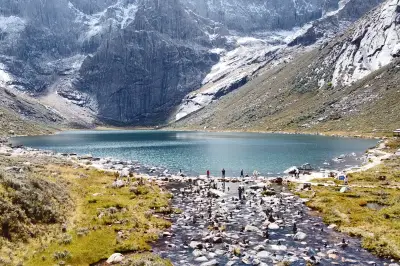
A Romantic Winter Journey: Reuniting with the Fairy Tale World of Jiuzhaigou in Emerald Seas and Blue Ice!
300 million years ago, glaciers ravaged and eroded, shaping Jiuzhai's unique valley landscape.
300,000 years ago, earthquakes and gravity joined forces, creating Jiuzhaigou's magnificent waterfalls and lakes.
Time brings great changes to the world, and after countless trials of nature,
Jiuzhaigou, with its breathtaking beauty, has become the pride of us Sichuanese!
Jiuzhaigou's history as a scenic area dates back to 1975, when the National Ministry of Agriculture, Forestry and Fisheries conducted a survey and discovered that it not only possessed rare natural scenery but also rich and precious animal and plant resources.
In 1984, Jiuzhaigou became one of the first national key scenic spots in China, gradually entering the public eye until it became known throughout the country and renowned worldwide. In 1986, when my parents were dating, they hitched a ride with a road maintenance crew to Jiuzhaigou. It took three days by car, a long and arduous journey, but even today they still speak of the beautiful scenery with great relish!
In our Sichuanese eyes, Jiuzhaigou is beautiful all year round: vibrant in spring, lush in summer, colorful in autumn, and pure and sacred in winter.
"If winter is a letter sent by God, then snowfall is the most beautiful love poem on that letter."
If you want to experience a romantic, frozen fairy tale world in Sichuan this winter, Jiuzhaigou, the golden signboard of Sichuan tourism, is not to be missed.
"All hardships are cultivation, all destruction is creation." After the "8·8 Jiuzhaigou Earthquake" and four years of protection and restoration, Jiuzhaigou has now returned with a full-area reopening.
Upon hearing the news of Jiuzhaigou's full reopening, as a Sichuanese who deeply loves Jiuzhaigou, I was extremely excited.
For the first trip of 2022, I invited friends to avoid the crowds, and we returned to Jiuzhaigou after the earthquake.
Unexpectedly, we ended up having the entire scenic area all to ourselves, experiencing an incredibly stunning journey!
After returning, I was so excited to share our joy with everyone.
Do you know just how beautiful winter in Jiuzhaigou is?
How did it win over us, who had seen its beauty in spring, summer, and autumn?
The answer lies in this travelogue.
So, please follow Yirui's lens and encounter an unparalleled winter journey!
Jiuzhaigou Scenic Area consists of three main valleys: "Shuzheng Valley, Rize Valley, and Zechawa Valley," forming a "Y" shape on the map.
The lower stem of the "Y" is Shuzheng Valley, whose mouth is the entrance to the scenic area; the left and right branches are Zechawa Valley and Rize Valley respectively; the main attractions of Jiuzhaigou are distributed in these three valleys; additionally, there is Zharu Valley, located to the left of Shuzheng Valley.
In winter, Jiuzhaigou is open in a limited area, but almost all the essential attractions can be visited, so everyone can rest assured and go. Attached is the Jiuzhaigou guide map:
As sunlight illuminates the distant mountain peaks, we also wake with the morning light. Entering the scenic area at 8:30, we take the first sightseeing bus and begin a fulfilling day's journey. After years of development, Jiuzhaigou has established a very comprehensive guiding system. Every time the sightseeing bus reaches an attraction, the on-board commentator gives a detailed introduction.
Heading up along the Emerald River, in the early winter morning, the snow-capped mountains of Jiuzhaigou are shrouded in mist, and the crisp air is filled with the freshness of nature. After entering the scenic area, our first stop is the 17-kilometer-long Rize Valley scenic line. This section features varied terrain and captivating natural scenery, and it is also the most essential part of Jiuzhaigou.
The first stop is Jiuzhaigou's calling card—Nuorilang Waterfall. It is the widest alpine travertine waterfall discovered in China to date.
I had admired its beauty in many promotional photos and videos, but standing in front of it, the sheer impact was so striking that it is truly unforgettable.
Nuorilang Lakes are the starting point of the entire Rize Valley, with an altitude of 2353m to 2365m. From an aerial view, the terrain can be clearly observed.
The roaring waters from more than 20 lakes of Nuorilang Lakes rush out through the forest, suddenly cascading down the edge of the cliff like the Milky Way falling, the sound vibrating through the valley.
After the 8·8 earthquake, when we saw in the news that the soil of Nuorilang Waterfall had collapsed and the trickling streams had become torrents, as a Sichuanese, I was truly heartbroken! After hundreds of water flow cleanings, the Nuorilang Waterfall has now restored its former grandeur. Even in winter, its majestic momentum is undiminished.
The winter waterfall curbs the unrestrained flow of summer. The cascading water freezes due to the cold, forming pure white, crystal-clear icicles and ice curtains. This seemingly frozen yet not fully frozen waterfall creates the most wonderful artwork of winter in Jiuzhaigou—ice waterfalls, making people marvel at the uncanny workmanship of nature.
We were also extremely lucky; the weather was clear during our two-day visit. Under the interplay of light and shadow, the ice waterfall was indescribably beautiful.
The combination of dynamic and static elements each exudes unique charm, composing the most beautiful poem of winter.
How to take a perfect photo with the beautiful ice waterfall of Nuorilang? The photographer demonstrates!
[Photography Tips]
1. It is recommended that the photographer stand on the top platform, with the subject standing on the edge of the second and third platforms below. Use a medium-telephoto lens to compress the distance, framing the person and the waterfall together. Moderately reducing the person's scale can effectively highlight the grandeur of the waterfall.
2. In sunlight, the waterfall splashes up mist. You can use a prime lens with a large aperture close up to capture elegant portraits in front of the waterfall.
3. Due to the angle, the sunlight time on Nuorilang Waterfall in winter is relatively short. When the waterfall is in shadow and the person is in sunlight, the warm-cold relationship between light and dark can be used in post-processing to enhance the color contrast, making the photo more outstanding.
"Nuorilang" means male god in Tibetan. Jiuzhaigou, made of water, is a kingdom of waterfalls, with 17 large waterfall groups alone. If Nuorilang is the undisputed king, then the next stop, the "queen"—Pearl Shoal Waterfall—is even more anticipated!
The second stop is Pearl Shoal Waterfall. For our generation born in the 80s and 90s, this waterfall is very familiar!
When the BGM of "You carry the load, I lead the horse..." plays in our ears, the scene of the master and disciples leading the horse through the waterfall automatically flashes in our minds.
Yes, this is the filming location of the 1986 TV series "Journey to the West." I remember as a child watching the actors walking on the turbulent waterfall, as if they could be swept into the water at any moment. Little me was really worried for them!
Getting off the highway and crossing the stream, the snow on the wooden boardwalk has been cleared, and non-slip mats made of burlap have been thoughtfully laid down.
On both sides of the boardwalk, the stream gushes happily from the woods, converging into a huge fan-shaped travertine shoal. The clear stream jumps and surges on the yellow-green travertine shoal.
After a night of severe cold, splashing water droplets hang on the branches, condensing into crystal-clear ice frost, magnificent and beautiful.
As the babbling stream flows to a sudden break, the water plunges down without warning, stirring up thousands of waves and producing a deafening roar. The cascading waterfall resembles countless white hada scarves, forming the largest travertine waterfall in Jiuzhaigou—Pearl Shoal Waterfall.
At this moment, the sun shines from the distant mountain peaks, casting warm sunlight on the earth. Countless water droplets splash from the waterfall, like pearls flying off a string.
Water mist also sublimates with the water droplets. In the bright light, it is crystal clear and full of spirit. When the water vapor encounters the branches beside the waterfall, it condenses, hanging on the twigs and shining with exquisite silver light.
Along the boardwalk down to the bottom of the waterfall, you can walk close to the waterfall and feel its magnificence up close.
Pearl Shoal Waterfall has an altitude of 2433 meters and a maximum drop of 40 meters. Even in the dry winter season, it remains extraordinary!
Against the backlight, sunlight illuminates every droplet. The dreamlike Tyndall light flows through the forest, as if arriving at a paradise on earth, invoking endless reverie.
Everyone was stunned by the scene before them. At this moment, the "queen" fully displays her gentle and charming side. Despite the passage of time and changes, she remains enduring, making visitors from afar unable to resist taking photos with her.
[Photography Tips]
1. For portraits, using the natural ice waterfall as a background, shooting against the light or from the side is the best choice, as sunlight outlines the subject's silhouette.
2. A tip for backlit shooting is to appropriately increase the exposure compensation parameters. With the subject exposed normally and the background slightly overexposed, you can capture a dreamy scene.
3. Set the aperture to the smallest, ISO to the lowest, and reduce the shutter speed to below 1/10 second. Even without a tripod, placing the camera on the ground or railing can achieve a silky slow-motion effect of the waterfall.
After taking photos, continue downstream along the stream. The wooden bridge built over the stream is illuminated by sunlight, intertwining reality and fairy tales.
On both sides of the boardwalk grow straight red birch trees. Last year in Hulunbuir, I witnessed the charm of white birch forests. Our red birches in Jiuzhaigou, Sichuan, also have an extraordinary temperament. In winter, they stand proudly in the ice and snow, with cracked bark and golden leaves returning to their roots, going back to the earth.
The dense forest bears witness to the achievements of Jiuzhaigou's ecological protection. The ultra-high forest vegetation coverage also makes it a natural oxygen bar. Every deep breath is full of negative oxygen ions, giving us a comprehensive purification from lungs to heart!
Do you know what exactly the blue of Jiuzhaigou is?
Is it sky blue? Lake blue? Emerald green? Azure? Or turquoise blue?
Students of art know that there are 41 shades of blue in the world, including deep blue, cobalt blue, dodger blue, navy blue, etc.
Like the numerous shades of women's lipstick, you might be able to distinguish lipstick colors, but when it comes to these colorful blues, you might be just as confused as I am!
Having just seen the two most magnificent waterfalls in Jiuzhaigou, we were still not satisfied, and then our souls were captivated by the lakes!
"Returning from Jiuzhai, you won't care for water elsewhere" is the highest praise people give to Jiuzhaigou's waters. Water is the soul of Jiuzhaigou, with 114 lakes large and small. Among them, the most worth lingering at is undoubtedly the colorful Five-Flower Lake before our eyes.
Five-Flower Lake is hailed as "one of the wonders of Jiuzhaigou." Unlike other lakes on the plateau, even in the bitter cold of deep winter, the waters of Five-Flower Lake remain full of vitality.
Due to travertine deposition, various algae, and centuries-old fallen trees sleeping at the bottom, plus the reflection of blue sky, white clouds, and lakeside trees, the entire bottom of Five-Flower Lake presents a colorful state.
There is a wooden bridge spanning the lake, which is an excellent place to appreciate the water colors. Walking on it, you can clearly see the lines hidden in the water. Large trees lie crisscross, wrapped by the lake water. Aquatic plants grow freely on their bodies, as if becoming corals. Occasionally, small fish swim and dart. Under sunlight, the lake surface sparkles with glistening light, creating a wonderful landscape.
The cold wind has stripped the forest of its colors, but the colorful lake water remains unpredictable.
We stood quietly by the lake, feeling its delicate tranquility, lingering for a long time!
Five-Flower Lake is a palette overturned by God himself, and also a real-life fairy tale world.
Since we are in a fairyland, naturally we want to take beautiful photos as mementos. So how to capture this lake well?
[Photography Tips]
1. The wooden platform by the lakeside near the scenic area parking lot is the C position of Five-Flower Lake. You can stand or sit on the edge of the platform while shooting. Be sure to pay attention to safety.
2. Using a wide-angle lens can perfectly combine the person and the scenery. Pay attention to placing the person's head as much as possible in the water area to avoid a dividing line at the horizon.
3. Using a medium-telephoto lens, standing on the stairs and shooting downward can compress the person into the lake water. If you happen to be wearing yellow clothing, it will create a perfect contrast of colors.
4. Using a telephoto lens, the photographer stands on the wooden bridge to shoot the platform, with the subject sitting by the lake. This is also an excellent angle.
Sister Eva is greeting everyone!
5. Walk along the boardwalk to the railing. The photographer shoots from the hillside downward. Under sunlight, the lake water will produce sparkling spots against the backlight. Using a large aperture can achieve very dreamy light and shadow effects.
6. Of course, the most superb angle is definitely aerial photography! If you can obtain a drone permit, be sure to bring all the batteries.
The people of Jiuzhai say: Five-Flower Lake is a sacred pool. Wherever its water spills, flowers bloom and forests flourish, bringing beauty and prosperity.
We were also captivated by its stunning beauty, reluctant to leave, and kept pressing the shutter to record its indescribable charm completely in our cameras, then share it with you in front of the screen, hoping that this joy healed by nature can also bring you the enjoyment of beauty!
Reluctantly leaving Five-Flower Lake, we continued forward. Landslides have occurred on both sides of Panda Lake, and the original boardwalk on the shore has been damaged. Seeing these traces left after the earthquake from the bus, we were filled with emotion. The staff explained that on September 28, 2021, Jiuzhaigou fully reopened; attractions such as Panda Lake and Arrow Bamboo Lake in the upper part of Rize Valley beyond Five-Flower Lake were also opened to the public after the earthquake.
The name Panda Lake is indeed related to pandas, as the Jiuzhaigou Nature Reserve is also a habitat for giant pandas. It is said that pandas love to come to this lake area to drink water and forage, hence the name.
Panda Lake is also one of the few lakes in Jiuzhaigou where fish can be seen. As the saying goes, "Water so clear that no fish can live." Jiuzhaigou's lakes are crystal clear, but there are very few fish species. The main reasons are two: low temperature and high mineral content.
But there is a magical kind of fish without scales on their bodies, as if they don't wear clothes, so the locals call them "naked fish."
This fish is actually a type of high-altitude carp, scientifically named "Gymnocypris." Currently, their numbers are very small and they are on the verge of extinction. They depend on this pure land and, like giant pandas, are worth cherishing and protecting!
Further up from Panda Lake is the last attraction of Rize Valley—Arrow Bamboo Lake.
After a long recovery period following the earthquake, the "made-up" Arrow Bamboo Lake is still breathtakingly beautiful.
Walking along the boardwalk, the arrow bamboo on the shore grows freely. Arrow bamboo is also a favorite food of giant pandas.
In this lake, there are also a large number of calcified dead trees, on which new trees have grown, creating a wonderful scene of "underwater forest."
"In Jiuzhai, all calm waters are not for boating, but a few glances are enough to rival the myriad colors of mountains and rivers."
Standing in the midst of this blue-green water, we gaze at the snow-covered peaks in the distance, feel the spirituality of all things in heaven and earth, and find inner peace.
The last few stops of Rize Valley are the primeval forest. Due to the dry season and forest fire prevention, it is currently not open. We have a bit of regret; we'll come back when the dry season ends!
Zechawa Valley is the left branch of the Y-shaped route, 17.8 kilometers long. The largest lake among the sources of all lakes in Jiuzhaigou, Long Lake, and the stunning Five-Color Pond are located here. This was also our farthest stop in Jiuzhaigou.
Long Lake is the lake with the highest altitude, the widest surface, and the deepest water in Jiuzhaigou Scenic Area.
I vaguely remember the scene of coming here in summer. Long Lake at the foot of the snowy mountains was ink-blue, a deep, charming blue.
In winter, Long Lake has turned into a huge ice lake. The water freezes into ice, and the snow-white lake surface reflects strong sunlight.
The unfrozen parts in the distance show a deep Prussian blue, while a small area of lake nearby is enchanting blue ice.
Blue ice is one of the six wonders of Jiuzhai scenery, and it is also the most mysterious and rare. Its formation originates from tiny bubbles in the ice. Blue light has a shorter wavelength and is scattered, making the ice appear blue.
This year is a warm winter. The last snowfall was after New Year's Day, but we could still find traces of residual snow on the shore, like a milk cover on the blue ice.
The cold wind blowing from the pass in winter has stripped Long Lake of its colorful colors. Under the majestic snowy mountains, the forest is layered and silent, like a frozen world.
Occasionally, a bird flies by, chirping and breaking the silence, and the mountains return echoes intermittently from afar.
The one-armed ancient cypress stands proudly on the shore. No matter how spring, summer, autumn, or winter change, it silently guards Long Lake. This tenacious spirit seems to possess an immensely powerful belief.
The staff told us that the most magical thing about Long Lake is that its water source comes entirely from the surrounding alpine snowmelt, but there is no visible outlet around Long Lake. Yet in summer and autumn, the water does not overflow the banks, and in winter and spring during prolonged drought, it does not dry up. The naturally formed regulation mechanism is fascinating.
The first time we saw Five-Color Pond was when we were taking aerial photos of Long Lake. When I turned the direction of the lens, that deep pool of still water hidden in the dense forest, like a sapphire, reflected the dazzling blue of the sky, instantly capturing our attention.
Five-Color Pond is the smallest lake in Jiuzhaigou, but it is the most colorful, hence its name.
Walking on the boardwalk a few times and looking from different angles, we were amazed that this is clearly clear and transparent water, yet it has colorful hues. Faced with this thickly painted, oil-painting-like wonderful scene, we were completely captivated.
The staff explained that these aquatic communities contain different depths of chlorophyll, which can display different colors in the calcium carbonate-rich lake water.
Observing carefully in the pond, you can clearly see the stones at the bottom, mostly angular with clear rock textures, adding a unique flavor.
Even more magical is that in the cold winter, there is residual snow around Five-Color Pond, but this small pond does not freeze!
It turns out that the water source of Five-Color Pond comes from underground infiltration from Long Lake. Because underground temperatures are constant year-round and flowing water does not freeze easily, Five-Color Pond is continuously supplied by Long Lake.
Shuzheng Valley is the lower part of the Y-shaped Jiuzhai Valley to the end of the valley mouth. After descending from Long Lake, we returned to the Nuorilang Visitor Center. After lunch there, the sightseeing bus began to head back out of the valley.
In the afternoon, the warm sun hung high in Jiuzhaigou. Walking a stretch, it was not cold at all, and even the felt temperature was higher than in overcast Chengdu. Strolling lazily towards the valley mouth, under the azure sky, different colors of trees and shrubs reflected in the lakes, gave a unique charm.
If water is the soul of Jiuzhaigou, and waterfalls are its emblem, then trees are the clothing of Jiuzhaigou.
The scenic sightseeing bus drove past the long Rhinoceros Lake and reached Tiger Lake. When we all marveled at the refreshing blue, a rumbling sound came to our ears. Before seeing the waterfall itself, we heard its sound. This is also the wonder of Shuzheng Waterfall.
Shuzheng Waterfall, 11 meters high and 62 meters wide at the top, is hidden under the bushes on the shore of Tiger Lake.
Following the descending boardwalk, the water in front is divided into thousands of streams by the bushes, falling towards the cliff, with mist dispersing, constructing a white water curtain.
Shuzheng Waterfall is located upstream of Shuzheng Lakes. Although it is the smallest of the four major waterfalls in Jiuzhaigou, its momentum is in no way inferior to the others.
The stream meanders down, flying and splashing through the valley forest, leaping over green moss. Sheets of water curtains rush out, forming a magnificent waterfall group.
Ancient trees and forests are full of vitality in the stream. Those old trees bend their trunks, rooted in the water, standing proudly in the rapids. After years of water flow impact, they remain graceful, swaying leisurely with the wind brought by the water, forming a special plant community. The wonders of nature are fully displayed here.
Passing through the Shuzheng Mill, the stream pushes the stone mill to rotate. Beside the bridge, there is a wooden house full of Tibetan style. The prayer wheel rotates continuously under the impact of the rapids. Devout Tibetan compatriots often come here to worship and chant.
Strolling on the bridge, the heart moves with the will. The winter sunlight passes through the branches, and among the dappled light and shadow, the forest stream is hazy and enchanting.
Ascending the observation deck beside Shuzheng Village, the well-layered lakes come into view vividly before us.
The entire Shuzheng Lakes consist of 19 lakes of different sizes gathered in a terraced form, with a height difference of nearly 100 meters, like a layered palette or emeralds embedded in a colorful frame.
Like blue agate, like emerald jade, this is probably God's most outstanding painting!
In Shuzheng Lakes, each lake is like a star, shining with its own light. Between the lakes grow tall trees such as willows, poplars, pines, and firs, as well as many kinds of shrubs. Although in winter the leaves have all fallen, leaving only desolate bare branches, it instead highlights the brilliance of the lakes hidden in the vast tree shadows.
Looking down at the lakes from a height, the shock is beyond words. It is precisely the organic connection of forests, lakes, and waterfalls, this natural beauty without any artificial carving, that together forms Jiuzhaigou's unique natural scenery, and we were again intoxicated.
The bus passes by Wolong Lake. A dragon formed by travertine lies coiled at the bottom of the deep blue lake. The next stop is the fairy tale-like Spark Lake.
Around the azure water surface are dense forests. The lake surface reflects colorful forests, refracting different colors under sunlight.
This crystal clear lake, when the sunlight reaches a certain angle, will sparkle like twinkling flames, jumping and flickering on the lake surface.
Although the sun had already set behind the mountains when we arrived, its beauty was in no way diminished.
After the 8·8 earthquake, a gap was formed at the edge of Spark Lake, and the lake dried up, exposing a uniquely shaped karst landform. That year, the Jiuzhaigou Administration repeatedly invited experts for on-site inspections. Through scientific demonstration and plan comparison, they ultimately chose traditional materials like glutinous rice mortar and rocks from the earthquake collapse as well as travertine soil for restoration, repairing the gaps and cracks in the dam of Spark Lake group, restoring the pre-earthquake ecosystem.
This plan was also affirmed and supported by UNESCO and the International Union for Conservation of Nature that year. We not only use technology and advanced techniques to protect nature but also now can restore nature.
The restored Spark Lake is not only a site of the earthquake but also a successful case of protecting and restoring the natural ecological environment of the world heritage site, and has become one of the must-see new attractions in Jiuzhaigou.
Reluctantly, we arrived at the last stop. Winter Reed Lake is a golden ocean, swaying in the wind and rustling.
A clear emerald belt meanders through the reed lake, dividing it into two halves, like a road leading to a fairy tale.
This river has the luster and color of beautiful jade, also known as the Jade Belt River. Legend has it that it was formed from the waist belt of the female mountain god of Jiuzhaigou, Wenuo Semo, and the beautiful face of the mountain god is hidden on the rock at the foot of the opposite mountain.
Reed Lake is also a habitat for water birds. Observing carefully, you can find herons and wild ducks playing freely in the water.
The gentle Reed Lake in winter emanates a magical halo, truly a watery landscape.
Here we watched the sunlight gradually fade, finally putting an end to our journey.
Hey! Jiuzhaigou, goodbye. We will meet again next time, right?
Most people prefer Jiuzhai in spring, summer, and autumn because of its colorful beauty, but those who have truly experienced Jiuzhai in all four seasons will love Jiuzhai's winter even more.
My biggest feeling from winter travel in Jiuzhai is: The valley has shed its noise, revealing a pure land, as if you can hear the sound of snow falling and see the traces of wind passing.
Only in such quiet encounters can you better appreciate its pure beauty. After all, having a fantastic lake all to yourself is a wonderful thing you can't even imagine in other seasons.
The winter love song has been played, the Jiuzhai fairy tale is being performed. I hope you can also, like us, encounter a perfect winter journey!
Do you think winter in Jiuzhaigou only has bare trees and frozen lakes?
Ice waterfalls, rime, blue ice, and colorful lakes—actually, the winter scenery of Jiuzhaigou is in no way inferior to other seasons.
Moreover, winter travel has fewer people, beautiful scenery, and saves money. Below, I've compiled a guide for winter travel in Jiuzhaigou.
■ About Tickets and Operating Hours
From November 16 to March 31 of the following year, Jiuzhaigou Scenic Area implements off-season ticket prices (ticket 80 yuan/person, bus ticket 80 yuan/person), totaling 160 yuan.
Entry time is also adjusted to 8:30 AM.
Peak season (April 1 to November 15): Ticket 259 yuan/person (including sightseeing bus).
Overall, the number of tourists in winter is low. You can take photos without avoiding crowds, and the sightseeing experience is excellent.
■ Transportation Strategy
【Self-driving】 Depart from Chengdu via "Rongchang Expressway - National Highway 213" (Chengdu - Wenchuan - Maoxian - Songpan - Jiuzhaigou), about 7 hours to reach Jiuzhaigou County.
Next year, the expressway from Mianyang to Jiuzhaigou will be fully opened, reducing the travel time from Chengdu to Jiuzhaigou to just 4 hours, cutting the journey time in half!
【Bus】 Take a bus from Chengdu's "Xinnanmen Station" or "Chadianzi Station" directly to Jiuzhaigou Scenic Area, about 8 hours.
【Plane】 Jiuzhaigou has its own airport (Jiuzhai Huanglong Airport), with flights to Chengdu (50 minutes flight time), Beijing, Guangzhou, and Changsha. Due to the pandemic, flights may be fewer currently, but this is the fastest way to get to Jiuzhaigou if budget is not a concern.
Currently, the overall road conditions to Jiuzhaigou are very good; regular cars can manage without issues. However, during occasional severe winter temperature drops, some road sections are prone to icing. To be safe, it is recommended to prepare snow chains in the car, slow down, and drive safely.
■ Accommodation Strategy
There are many accommodation options at the mouth of Jiuzhaigou Valley and in Jiuzhaigou County, including hotel-grade options and Tibetan-style guesthouses.
If you want to be close to the scenic area, it is recommended to stay at the valley mouth. The hotel conditions here are very good, with plenty of rooms available due to low winter tourist numbers. Staying here, you can go up to the mountain to sightsee early the next morning.
■ About Itinerary Planning and Other Attractions Along the Way
For self-driving tours of Jiuzhaigou, a 4-day itinerary is recommended. If you want to explore Jiuzhaigou in depth and don't want to rush, it is suggested to buy a 2-day pass to visit all attractions. If you finish in one day, you can go to Huanglong the next day.
DAY1: Chengdu — Visit Maoxian (visit Ancient Chinese Qiang City, Pingtou Qiang Village, Baishi Qiang Village) — Outside Jiuzhaigou Scenic Area
DAY2: Visit Jiuzhaigou
DAY3: Visit Jiuzhaigou or Huanglong
DAY4: Return trip to visit Songpan Ancient City, then return to Chengdu.
【Epidemic Prevention Policy】
1. It is strongly recommended that friends driving from Chengdu to Jiuzhaigou get a nucleic acid test in advance. On the way from Chengdu to Jiuzhaigou, every county you pass will check your health code and scan the venue code. There are a total of five checkpoints. Bringing a 48-hour nucleic acid test certificate will make passing through stress-free.
2. All tourists within Sichuan must apply for and use the "Sichuan Tianfu Health Code" and the communication big data travel card. Only green codes allow ticket booking. Red and yellow code tourists cannot book tickets and are prohibited from entering the scenic area.
3. Tourists from medium- and high-risk areas are temporarily not accepted for ticket booking according to epidemic prevention requirements.
4. According to the latest epidemic prevention policy, all tourists from other provinces must provide a nucleic acid test report within 48 hours (calculated from the time of entering the scenic area) to enter the scenic area.
5. According to current epidemic prevention requirements, tourists who have a history of traveling to prefecture-level cities with medium- and high-risk areas or districts where provincial capitals and municipalities directly under the central government are located within 14 days will be temporarily suspended from reception.
【Tour Notes】
1. Jiuzhaigou is a high-altitude area. Avoid strenuous exercise and excessive drinking. It is advisable to prepare common medicines in advance for emergencies.
2. Winter in Jiuzhaigou has a large temperature difference between day and night. Please bring enough warm and cold-proof clothing.
3. Prepare sunscreen and sun hats to protect your skin from the strong ultraviolet rays of the plateau.
4. In the scenic area, you will be taken around by sightseeing bus. It is recommended that friends plan their play time and enter the scenic area early to fully appreciate the beauty of the fairy tale world.
Thanks to Aunt Long and Sister Eva for the invitation, and thanks to Bubbles for helping with the photography. The first trip of 2022 is perfect!
Travelogue Contents: 1. Preface 2. Jiuzhaigou Scenic Area Guide 3. Rize Valley 4. Mysterious and Spectacular Blue Ice and Ice Falls—Nuorilang Waterfall 5. Dreamy Encounter of Pearls and Warm Sun—Pearl Shoal Waterfall 6. Colorful Heavenly Pool—Five-Flower Lake 7. "Made-up" Return, Still Beautiful—Panda Lake & Arrow Bamboo Lake 8. Zechawa Valley 9. Source of Frozen Lakes—Long Lake 10. Sapphire Embedded in Dense Forest—Five-Color Pond 11. Shuzheng Valley 12. Water Dance Among the Trees—Shuzheng Waterfall 13. Natural Gallery—Shuzheng Lakes 14. "Phoenix Nirvana, Rebirth from Fire"—Spark Lake 15. Reed-Growing, Waterbird Habitat—Reed Lake 16. Epilogue 17. Jiuzhaigou Travel Tips: Travel Information, Hotel Index, Strategy Index, Ticket Index, Website Navigation, Travel Index, Cruise Index, Corporate Travel Index, Franchise Cooperation, Alliance Links, Friends Links, Corporate Gift Card Procurement, Insurance Agency, Agent Cooperation, Hotel Franchise, Destinations and Scenic Area Cooperation, More Cooperation, About Ctrip, About Ctrip, Ctrip Hotspots, Contact Us, Careers, User Agreement, Privacy Policy, Business License, Security Center, Ctrip Content Center, Intellectual Property, Trip.com Group Algorithm Disclosure