Rowing a Small Boat, Let Me Roam — A 5-Day Trip to Jiuzhaigou/Huanglong During 2021 National Day (A Complete Guide to Direct Flights to Jiuzhaigou)
2021 was a special year for me. In the first half of the year, I just finished a 14-day honeymoon. During the honeymoon trip, we spent 2 days in Chengdu, and at Dujiangyan, the guide strongly recommended that we come to Jiuzhaigou in October. On one hand, the autumn scenery of Jiuzhaigou is very beautiful, with abundant water flow (when we went to Dujiangyan in March, it was the dry season and the riverbed was dry). On the other hand, due to the impact of the pandemic, the number of visitors to Jiuzhaigou has decreased significantly compared to before. Moreover, many students are currently unable to leave their own provinces and cities, so there might be mainly local tourists from Sichuan. Considering that it's usually not convenient for me to take leave, I decided to make good use of the 7-day National Day holiday and have a festive trip!
DAY 1 (October 2): Shanghai (high-speed rail) → Wuxi (plane) → Jiuzhaigou Huanglong, stay near the entrance of Jiuzhaigou
DAY 2 (October 3): Jiuzhaigou (first entry), stay near the entrance of Jiuzhaigou
DAY 3 (October 4): Jiuzhaigou (second entry) → Chuanzhusi Town, stay at Chuanzhusi Town
DAY 4 (October 5): Huanglong Scenic Area, stay at Chuanzhusi Town
DAY 5 (October 6): Jiuzhaigou Huanglong (plane) → Wuxi (high-speed rail) → Shanghai
I. Intercity Transportation
During the National Day holiday, there were no direct flights from Shanghai to Jiuzhaigou. Either a transfer via Xi'an or Chengdu from Shanghai, both taking a long time, and the prices were higher than direct flights from Wuxi. The flight time from Wuxi was very good: departing at 13:00 and arriving at 16:00; returning at 09:20 and arriving at 12:05. Even including the high-speed rail time from Shanghai to Wuxi, it was at most 1-2 hours.
I chose Sichuan Airlines. I had always heard about the "nine out of ten flights to Jiuzhai are delayed" joke about Jiuzhai Huanglong Airport, but it reflects the difficulty of flying at plateau airports. In case of an emergency, Sichuan Airlines, being the local airline, would be more convenient even if it had to return to Chengdu Airport. However, this trip went smoothly except for delays of about 2 hours each way.
Booking tickets on the Sichuan Airlines official website, the round trip per person (including insurance and airport construction fee) was 3620 yuan, meaning a one-way ticket was 1810 yuan.
(A) Outbound on October 2: Shanghai Hongqiao Station → Wuxi New District Station → Wuxi Sunan Shuofang Airport → Jiuzhaigou Huanglong
1. High-speed rail: Shanghai Hongqiao → Wuxi New District D3060, departing 09:46, arriving 10:33
(1) Since it was the peak travel day of the National Day holiday, I took a taxi from home at 8:00 and arrived at the train station at 8:30. It was crowded. Epidemic prevention measures mainly involved scanning health codes and travel codes, which didn't take long.
(2) Wuxi has three train stations. Wuxi New District Station is the closest to the airport, only a 20-minute ride on the subway for 3 stops to Shuofang Airport, so Wuxi New District Station was definitely the first choice. National Day tickets were hard to buy. I brushed for tickets as soon as they became available 14 days in advance. I bought the return train ticket a bit late, so I only got Wuxi Station, not Wuxi New District Station.
(3) For the subway in Wuxi, you can use the Wuxi subway card in Alipay to scan the QR code and enter the station, which is very convenient.
2. Flight (Sichuan Airlines)
Wuxi → Jiuzhaigou Huanglong Airport (outbound) 3U3728 Airbus 319
Original plan: Depart from Wuxi Shuofang Airport T2 at 13:00, arrive at Jiuzhaigou Huanglong (Jiuzhai) Airport at 16:00, baggage allowance 20KG.
Actual: Due to air traffic control, the flight from Jiuzhaigou was delayed by 2 hours. We boarded at 3:00 and took off around 3:30. The actual flight time was 2 hours 40 minutes, arriving at Jiuzhai Huanglong Airport smoothly a little after 6:00.
(B) Return on October 6: Jiuzhaigou Huanglong Airport → Wuxi Sunan Shuofang Airport → Wuxi Station → Shanghai Hongqiao Station
1. Flight (Sichuan Airlines)
Jiuzhaigou Huanglong Airport → Wuxi (return): October 6, 2021 (Wednesday) 3U3727 Airbus 319
Planned: Depart from Jiuzhaigou Huanglong (Jiuzhai) Airport at 09:20, arrive at Wuxi Shuofang Airport T2 at 12:05, baggage allowance 20KG.
Actual: Due to weather, the flight took off at 11:55. The flight lasted 2 hours 20 minutes, arriving at Wuxi smoothly at 13:15.
About boarding: The previous night, there was heavy rain in Songpan. At 6:00 am, I checked my phone and saw the flight was delayed to 11:55. I quickly contacted the driver to postpone the originally scheduled 7:30 pickup to 8:00. The drive from my hotel in Chuanzhusi Town took about 20 minutes, smooth without traffic jams, except for some congestion on the township roads. When I arrived at the airport at 8:30, the counter staff hadn't started work yet; they started at 9:00, so we had to wait. No need to rush at all.
2. High-speed rail: Wuxi → Shanghai Hongqiao G7139, departing 16:28, arriving 17:18
This time on 12306, I brushed for tickets too late and couldn't get tickets to Wuxi New District, so I had to depart from Wuxi Station. It is 40 minutes by subway from the airport, also on Subway Line 3 directly, quite convenient. Follow the signs from the subway to the 3rd floor for the train station entrance. There are Burger King and McDonald's in the underground mall if you need to eat.
The security check at Wuxi Train Station is quite strict; they will detect alcohol, hand sanitizer, etc., in your luggage and ask you to open it for inspection.
Jiuzhaigou and Huanglong Scenic Area are about 1 hour 40 minutes apart by car. If you don't change hotels, the journey can be tiring. And since our flight was quite early, going from Jiuzhaigou was too far. So besides the hotel near the entrance of Jiuzhaigou, we also chose a hotel in Chuanzhusi Town, which is 30 minutes to Huanglong and 20 minutes to the airport, which felt suitable.
a. Jiuzhaigou Jinlong International Holiday Hotel (Superior King Room): Check-in October 2-4, 2 nights. Booked half a month in advance at 770 yuan/night, but by the end of September, the price had soared to 1500 yuan/night.
Address: S301, Jiuzhaigou County, Aba Tibetan and Qiang Autonomous Prefecture, Sichuan Province (3 km from Jiuzhaigou Scenic Area entrance)
Services: Free airport pickup (reservation required 1 day in advance), drop-off at own expense. Free shuttle bus to the entrance in the morning (return on your own), about 4-5 km from Jiuzhaigou scenic area gate. Free breakfast buffet, dinner buffet 60 yuan/person, or a la carte.
b. Songpan Yari International Hotel (Deluxe King Room): Check-in October 4-6, 2 nights. Booked half a month in advance at 494 yuan/night.
Address: No. 47 Jinxing Road, Chuanzhusi Town, Songpan County, Aba Tibetan and Qiang Autonomous Prefecture, Sichuan Province
*About 2 km from the Red Army Long March Monument, about 17 km from Songpan Ancient City, about 32 km from Mouni Valley, about 40 km from Huanglong Scenic Area, and 14.62 km from the airport.
Services: Oxygen in the room; pay a 60 yuan start-up fee to continuously inhale oxygen. Free breakfast buffet. Free airport pickup, but drop-off at own expense.
Other references: I also saw in many travelogues that for visiting Huanglong, staying in Songpan Ancient City is recommended. The altitude there is relatively lower, and it has richer commercial facilities. It is also a cultural attraction with ancient city walls, an ancient city that Princess Wencheng passed through on her way to Tibet, with statues of Princess Wencheng and Songtsen Gampo. It is said the night view is quite beautiful. But the disadvantage is that it is farther from Huanglong and Jiuzhai Huanglong Airport. I was worried about traffic jams during National Day delaying the trip, so I chose to stay in Chuanzhusi Town.
Weather and Clothing
During National Day, the weather in Jiuzhaigou and Huanglong is late autumn, with temperatures ranging from over ten to over twenty degrees Celsius, cooler in Huanglong.
Jiuzhaigou morning: Autumn jeans (no need for leggings or long johns), a long-sleeved shirt (thin), a light down jacket (light enough, no need for a thick winter one). It's recommended that the down jacket has a hood to resist wind.
Jiuzhaigou noon: It's warm when the sun is out; take off the morning down jacket and put it in the bag. In shaded areas, you can drape a large cashmere shawl to avoid catching a cold.
Jiuzhaigou after 3 pm: The sun is mostly blocked by clouds, slightly cool and windy; put on your down jacket again.
Huanglong morning: Autumn jeans (no leggings or long johns), a long-sleeved shirt (thin), a sweatshirt (can be fleece-lined), a light down jacket (light enough, no need for thick winter one). Hood recommended for wind resistance.
Huanglong noon: Take off the down jacket; still need the sweatshirt and shirt.
Huanglong afternoon: Put the down jacket back on.
In addition, although it rains continuously in the Jiuzhaigou and Huanglong area, it is still very dry. Lip balm, face cream, and sunscreen are all essential. Also drink plenty of water to stay hydrated. I suspect I became dehydrated on the first day.
High Altitude Sickness
It wasn't my first time in a high-altitude area. Previously, I flew directly to Lijiang and didn't have altitude sickness on Jade Dragon Snow Mountain the next day (I took Rhodiola 7 days in advance). However, the altitude at Jiuzhaigou and Huanglong felt higher, and the amount of exercise was unusually large, making it easy to lack oxygen (even though my husband and I started taking Rhodiola a week in advance, we still suffered from altitude sickness).
One week before departure, I started taking Tongrentang Rhodiola, 2 times a day, 3 pills each time. The bottle was generous, costing about 80 yuan. Later, I saw that a friend who had been to Tibet recommended Gaoyuan'an, so I splurged on Taobao and bought 2 boxes of Gaoyuan'an. The instructions said it didn't need to be taken in advance; it could be taken after arriving at the plateau. I wondered if it was a waste of money, but when I had a splitting headache and felt like vomiting on the first day at Jiuzhaigou, I took 3 pills immediately. After 2 hours, the symptoms eased significantly. After sleeping overnight, I felt better the next day.
When I arrived at Chuanzhusi Town at an altitude of over 3000 meters, I had almost no altitude sickness symptoms. There was oxygen in the hotel room, but I didn't use it. It seems that medication plus adequate rest is the best help for relieving altitude sickness.
If the medication doesn't work, you should immediately inhale oxygen. I heard from my best friend about her experience in Shangri-La: a headache from altitude sickness was relieved immediately after inhaling oxygen, and she got used to it after a while.
For Huanglong, it is recommended to prepare a portable oxygen canister. No need to buy it in advance; buy it at the scenic area. There are oxygen stations and small shops along the way. It costs only 15 yuan per can at the scenic area, exactly the same as the 25-yuan one I bought at the supermarket opposite my hotel. And don't buy too many; one can per person is enough.
Tickets for Jiuzhaigou and Huanglong Scenic Areas can be reserved 14 days in advance via WeChat official accounts.
Detailed itinerary begins~
I heard from everyone that during National Day, tourists in Sichuan were endless. The national highway from Chengdu to Jiuzhaigou was congested. Some friends set off at 5 am and didn't arrive at Jiuzhaigou until 1 am. So I decisively chose to fly directly to Jiuzhai Huanglong Airport and didn't arrange any activities for that day.
This decision was right because we still encountered a flight delay. Due to air traffic control, when I arrived at the airport at 12:00, I was ruthlessly informed that the plane would not board until 3:00. Originally, we would have taken off at 1:00 and arrived at the airport by 4:00, but now we were delayed by 2 hours. However, with the psychological preparation of "nine out of ten flights to Jiuzhai are delayed," I felt lucky that it was only 2 hours!
My route: Shanghai (high-speed rail) → Wuxi (plane) → Jiuzhaigou Huanglong. This National Day trip was quite an adventure. From Shanghai to Wuxi, the journey was smooth. I took a taxi from home at 8:00 and arrived at the train station at 8:30. Epidemic prevention measures mainly involved scanning health codes and travel codes, which didn't take long, except for the crowds.
But at the airport, the trouble began during security check because all self-heating food was not allowed on the plane! Previously, my husband had brought a self-heating rice on a flight to the US, but this time it wasn't allowed. Not only that, even SF Express wouldn't let me send the self-heating food home. To mail it, I had to remove the heating pack.
Look at my variety of self-heating hot pots. I had to unpack them all, remove the heating packs, send the rice home, and travel lighter.
After mailing the self-heating pots, I rushed through security, bought some KFC, and entered the waiting hall at 12:10. Only then did I see on the screen that the flight was delayed by 2 hours, just having departed from Jiuzhaigou not long ago. So why was I in such a hurry? I was dumbfounded. I ate my KFC peacefully and waited. Fortunately, the plane arrived at the airport on time around 2:00, and we boarded smoothly at 3:00.
The flight from Wuxi to Jiuzhaigou was fully booked. To celebrate the National Day atmosphere, the national flag was placed on the luggage racks, creating a sea of red. Sichuan Airlines recently launched a "red-hot" in-flight meal, which was really unpalatable—little meat, various mushy textures, and flavorless red pepper shredded pork. I wonder what happened to the praised Sichuan Airlines cuisine online.
The plane flew fast. In about 2.5 hours, we arrived at Jiuzhai Huanglong Airport. By 6:30 pm, the sky was already getting dark!
As a mountainous plateau airport, I must say that as soon as we landed, my husband and I started to feel altitude sickness. We couldn't breathe properly even with masks on. We quickly took out Gaoyuan'an and ate 3 pills.
The pick-up driver, Mr. Liu, was already waiting at the airport. He was very nice, helped us with our luggage, drove very steadily, and made us feel safe on the mountain roads at night. We found out he was a former soldier. He gave us a lot of useful tips about visiting Jiuzhaigou, without any sales pitch. He was much better than the greasy Mr. Huang who drove us to Chuanzhusi Town on the third day.
From the airport to the hotel near the entrance of Jiuzhaigou, it would normally take about 1.5 hours, but during National Day it was really congested, with red sections everywhere. We arrived at the hotel around 10 pm.
After a dusty journey, we were worried that the hotel wouldn't have dinner. Mr. Liu was very kind and offered to wait for us to drop off our luggage and take us to eat nearby. But fortunately, the hotel had dinner available: a buffet for over 60 yuan or a la carte. We didn't see much on the buffet, so we ordered spicy chicken, shredded cabbage, a bowl of beef noodles, and a bowl of rice, totaling 126 yuan. It tasted good.
The hotel lobby was quite impressive, and the front desk upgraded us to a deluxe king room for free. The facilities were a bit dated but comfortable, and the room was spacious. Hot water with good pressure was also a plus.
We made a reservation at the front desk for the next morning's shuttle to Jiuzhaigou. The shuttle ran from 7:00 to 9:00. Following Mr. Liu's advice, we wanted to enter the scenic area as early as possible, so we booked the 7:00 departure.
As it turned out, when the scenic area is fully loaded with 41,000 people, if you don't leave early, you'll face a situation where cars can't even get near the scenic area. Approximately 2.5 km before the entrance, it was already red congestion, and you'd have to walk 2.5 km to the entrance.
Unless you stay in the town within 1 km of the entrance, where accommodation conditions might be relatively poorer, but living close is a fantastic choice during the peak tourist season.
Before going to bed, I continued taking Gaoyuan'an because the altitude at the two forks in Jiuzhaigou can reach 3000 meters. Unfortunately, the next day I still suffered from altitude sickness despite taking the medication.
At 6 am, I opened the curtain. The sky was still dim, and the ground was wet from rain. To catch the 7 am shuttle, we got ready early. At 6:40, we went to the hotel restaurant and found many tourists already eating. Everyone wanted to leave early. The hotel breakfast offered Chinese, Western, and noodles, but the taste was mediocre. However, we tried to eat as much as we could.
The hotel shuttle departed when full. The one we caught had 6 seats, so we left soon. When we reached about 2.5 km from the scenic area, traffic was red and barely moving. Indeed, for a scenic area at full capacity of 41,000, one must be mentally prepared for this. The driver was very kind and tried to move forward as much as possible to save us walking distance. At about 1 km away, we told him to let us out and walk because walking was faster than driving.
This was the crowd at the entrance of Jiuzhaigou Scenic Area at 7:00 am on October 3. It was already considerable.
At the entrance, we first had to scan the travel code. After the staff verified it, they let us into the passage, and then we swiped our ID cards to enter the scenic area directly.
Once inside, we saw many people lining up for the scenic area buses. The transportation within the scenic area was very fast. Even if you see a long line, don't worry; be patient. For the first bus, make sure to get a seat because the first bus usually travels a long distance, up to half an hour. Standing would be inconvenient. For later stops, the distances between stops are shorter, so standing is fine.
When taking the bus uphill from the entrance, it is recommended to sit on the left (near the driver), because except for the scenic spots in Rize Valley on the right, the views of the other two valleys are on the left. As the bus goes up, there are TVs that play explanations at each scenic spot, allowing you to enjoy the scenery and listen to the commentary.
Jiuzhaigou gets its name from the nine Tibetan villages living on this beautiful land. However, since six villages are deep in the mountains, we can only see three Tibetan villages within the scenic area. According to friends who have been there and locals, there are now homestays in the Tibetan villages inside the valley. Some people buy a one-day ticket and stay inside to continue playing the next day. However, the scenic area may check strictly now. My friend said the accommodation conditions were not great—very cold at night, poor heating. She was freezing. But staying inside can reduce commuting time, especially when roads are jammed; walking is painful.
The tour route in Jiuzhaigou is shaped like a "Y," with Zechawa Valley on the upper left, Rize Valley on the upper right, and Shuzheng Valley below. This time we were very lucky because the entire area had just fully reopened after the earthquake. The three valleys meet at Nuorilang Waterfall, where there is a large service area with restaurants, shopping centers, smoking areas, a police station, etc. You can also change buses here to go to different routes.
From the map, you can see the distribution of scenic spots. Zechawa Valley has only two spots: Long Lake and Five-Color Pond. Few, but Long Lake is the largest lake in Jiuzhaigou, the mother lake, vast and magnificent. Five-Color Pond is my personal favorite, with colors dancing in the sunlight. So despite the few spots, they are very distinctive.
Rize Valley has many scenic spots along the way, among which Five Flowers Lake and Pearl Shoal Waterfall are must-visit check-in points. I went to Five Flowers Lake on the second day, and the weather was bad, so the view was much worse than Five-Color Pond on the first day. But Pearl Shoal Waterfall was really beautiful. Walking along, you could see countless pearls falling on a jade plate. And the opening scene of the 1986 TV series "Journey to the West," with the theme song "You carry the load, I lead the horse," was filmed at Pearl Shoal Waterfall. As a loyal fan of the 1986 version, this scene is very memorable. I think if you have enough time, you must walk the forest plank road from Primeval Forest to Arrow Bamboo Lake Waterfall, passing Swan Lake and Grass Lake. It is incredibly beautiful; you must immerse yourself. The Arrow Bamboo Lake Waterfall is somewhat similar to Shuzheng Lakes, with water flowing through the forest, very distinctive.
Shuzheng Village also has many attractions, notably Shuzheng Lakes, Shuzheng Waterfall, Spark Lake, and Double Dragon Waterfall. However, Spark Lake was quite affected by the earthquake. It was raining when we went, so we didn't see the lake surface sparkling like flames in the sun, which was a pity. The section from Shuzheng Lakes to Shuzheng Waterfall is the highlight and recommended for walking. Reed Lake and Bonsai Shoal I didn't get off to visit due to time constraints; only glimpsed from the bus. I really wanted to walk through Reed Lake because there is a jade belt river cutting through the reeds, like the waistband of the goddess Semo, very beautiful.
On the first day, I entered early and was directly taken by bus to Long Lake. Then I walked to Five Flowers Lake, then took the bus to Nuorilang Waterfall Center. After lunch, we took a bus to Rize Valley's Primeval Forest. From Primeval Forest, we walked 3.5 km along the wooden plank road to Arrow Bamboo Lake Waterfall. Then I got altitude sickness and slept in the scenic area for 1 hour. After that, we continued to Panda Lake. Later, after the sun went down, we felt that Five Flowers Lake might not look as good, so we exited at around 16:50. Let me show some photos from the first day.
First stop: Long Lake
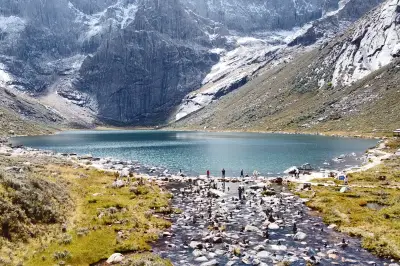
In the morning, the sun was still behind thick clouds, so Long Lake wasn't sparkling. There were not many tourists, giving a peaceful feeling. Strolling along the wooden plank road by Long Lake, surrounded by mountains, the blue-green water was deep and serene. Although autumn hadn't turned the leaves red yet, the yellow-green leaves quietly announced autumn's arrival.
Long Lake is a plateau barrier lake, the highest-altitude scenic spot in Jiuzhaigou. In the shallower areas, you can see tree trunks underwater, as if sealed in the blue-green lake, immortalized. The trunks lying in the water without sinking, slanted and natural, have their own charm.
When the sun came out, the leaves became translucent and colorful, and the lake surface glowed differently, with clearer reflections of the mountains.
Morning dressing guide: Thick sweatshirt with a shirt underneath, not cold at all!
This is a characteristic plant of Jiuzhaigou—the "one-armed old man," or more romantically, the "one-armed hero." One side is lush with leaves, the other only has short branches.
On the forest plank road from Long Lake to Five-Color Pond, we saw fallen tree trunks covered with fine moss. The sunlight filtered by the trees gently fell on the moss, creating a soft atmosphere.
Passing by prayer flags, rich in color, devout blessings. In Jiuzhaigou, you can see many details that show believers' devout prayers and their love and awe of nature.
Under the prayer flags, there were many small light purple flowers, delicate and lovely, dotting the meadow.
Although it's said that "after visiting Jiuzhaigou, no other water scenery is worth seeing," for us southerners, the mountains in Jiuzhaigou are also magnificent and unique. Unlike the gentle green mountains of Jiangnan, these mountains are lofty and rugged, the primeval forests growing with strength.
After walking for a while, we arrived at Five-Color Pond.
Because Five-Color Pond is relatively small, the surrounding plank road was crowded with people. But if you walk slowly and wait patiently, you can still find opportunities to get close and take photos.
The trees reflected in the pond water like a mirror of the sky. After the sun came out, the colors of the pond became even more vibrant.
Five-Color Pond was my favorite among all the spots in Jiuzhaigou during my two-day visit. I lingered there for a long time, reluctant to leave.
After visiting Five-Color Pond, we took the bus to Nuorilang Center. Along the way, we passed Upper Seasonal Lake and Lower Seasonal Lake, which we just saw from the bus as there were no stops.
At around 10:30, we arrived at Nuorilang Service Center. Besides the restaurant, there was a shopping center selling local souvenirs. Since I had checked the menu of the buffet online and didn't like it, I bought instant noodles and ate them with our own snacks. It is recommended to buy instant noodles at the souvenir shop inside the shopping center; they are cheaper than at the dedicated food stalls—10 yuan per cup, and they will prepare it for you. During the trip, I was glad I didn't carry the self-heating pots, as they would have been too heavy. At Nuorilang Service Center, various self-heating rice meals were available at reasonable prices.
After lunch, we continued by bus to Rize Valley on the right. Third stop: Primeval Forest.
We got off at the Primeval Forest terminal. I wanted to hike up, but my husband suggested saving energy. He thought walking on the forest trail was enough to see the primeval forest; there was no need to climb at such high altitude. Besides, at noon, the Primeval Forest area was full of tourists eating on the ground, with the smell of various self-heating pots and food mixing together, not ideal for sightseeing.
The route we chose was to walk along the wooden plank road from Primeval Forest for 3.5 km to Arrow Bamboo Lake Waterfall. This section is very long, but the scenery is beautiful and distinctive. If you can't walk much or are short on time, take the bus. If you have time and energy, walking is highly recommended.
The babbling stream, threading through the forest, with soft sunlight shining on the forest stream, felt like a fairy tale world.
This is a corner of Grass Lake. Light green water plants covered the lake surface like light feathers, swaying at the bottom. The clear lake had lush water plants at its edge, then dense trees, and then rolling mountains in the background. The composition was so beautiful.
This blue-green river is called Peacock River, with the color of peacock stone, stretching for miles. Red maple leaves created a striking color contrast.
The rapid water hitting rocks created white waves like lace trimmings.
Fluffy water plants emerged from the lake, creating different large-scale patterns, like vivid freehand color paintings. It turns out green has so many different shades.
I deeply felt the natural art of nature—"Clear waters and green mountains are as good as mountains of gold and silver."
People often say that the mountains and rivers of Europe are beautiful. Although I haven't been there myself, this trip to Jiuzhaigou made me feel that our motherland's landscapes are no less impressive. There is no need to worship foreign things. Only by truly calming down, not rushing, and savoring the graceful scenery can you truly communicate with it and feel the changes of millions of years of crustal movements and the vast power of nature.
The beautiful scenery gained during the hike. At noon, it was quite hot under the sun.
Finally, we arrived at Arrow Bamboo Lake. Arrow Bamboo Lake also has a circular plank path. I wanted to walk around it, but at that time, I was experiencing altitude sickness. I had a splitting headache. I quickly found a place to sit and slept for an hour, from 2:00 to after 3:00. I felt that if we walked the circular path, it might be too late. So we continued along the outer path. If I had any experience, I shouldn't have been so stubborn; I should have taken the scenic area bus. But I was reckless. I kept walking, reached Panda Lake, and only went back when I was completely exhausted. On the way back, I couldn't get a taxi, and it started raining heavily. I had to walk about 5 km in the rain. What a disaster! But that's a story for later.
Floating aquatic plants looked like a delicate bonsai. Arrow Bamboo Lake's small waterfall. It was my first time seeing arrow bamboo and also the first time witnessing water flowing through the forest—very magical.
I especially admired how the scenic area's plank paths were built over the water, allowing us to walk among it while protecting the ecology. The landscape architects and builders were truly ingenious and admirable.
These row of "villas," or rather row waterfalls, is Arrow Bamboo Lake Waterfall. Not particularly tall, but numerous, interlaced, and echoing each other, showing the agility of water.
The trees constantly battered by the water flow were remarkably resilient, showing no sign of decline, constantly branching out. It seemed that the water and trees, once in conflict, had gradually become harmonious, coexisting in this area.
Finally, we reached the last stop of the first day: Panda Lake.
I was curious why it's called Panda Lake. Is it because pandas used to live here? There are two theories: one is that a long time ago, many pandas did inhabit and breed around this lake; the other is that when the lake dries up, the exposed riverbed shows black and white colors like a panda's fur. Which theory do you pick?
I think both are possible. Especially the first one, since Panda Lake is close to Arrow Bamboo Lake, which provides abundant food for pandas. This place would be a paradise for pandas.
I felt the mountain around Panda Lake was a bit bare, with serious soil erosion. Next to Panda Lake is a tunnel, probably built to ensure driving safety and prevent falling rocks.
Around 4:00, exhausted, we took a bus from Panda Lake back to the exit. After a 30-minute ride, we arrived at the gate at 4:30, which was also the peak departure time. The road was single-lane and extremely jammed. During National Day, U-turns were not allowed, so cars could only crawl forward. Even with surge pricing on Didi, no one picked up our order. And even if someone did, they would have to wait a long time to reach the gate and then face heavy traffic on the way.
Deciding to walk and see, we eventually walked all the way back to the hotel.
During the walk, I made some observations:
1. The pedestrian paths in Jiuzhaigou are now very modern, all made of plastic track, so just follow the track with navigation and you won't get lost.
2. If you see a supermarket on the way back, go in and stock up on food and drinks. Some shops also have fruit. For example, near the Jinlong International Holiday Hotel where I stayed, there was only one shop in the hotel, with higher prices and fewer items. Going out again was exhausting.
3. If traveling during National Day or peak season, it's best to stay as close to the entrance as possible. The town at the entrance is quite prosperous now, with KFC, Bashu Dajiang hot pot, steam pot fish, etc. If you can't get a taxi, a 1 km walk is manageable. The Jinlong Hotel 4-5 km away has good accommodation, but when you can't get a taxi, it's really tough.
We had dinner again at the hotel restaurant, ordering boiled fish, dry pot cauliflower, and a sweet and sour pork that was all batter, not sweet at all. We ate quickly and went back to rest. Too tired to take pictures of the food.
That evening, we discussed the next day's itinerary. Given the afternoon's painful experience and the 4-hour traffic jam from the airport to the hotel, we planned to leave Jiuzhaigou before 13:00 on the second day to avoid peak hours. We contacted the driver from the first day and arranged for him to take us.
It rained again all night, and it was still drizzling in the morning. We were too tired from yesterday to enter the scenic area early. Our plan for today was to take as many buses as possible and minimize walking.
That day, the hotel shuttle was lazy. Seeing traffic ahead, it dropped us off on the road about 2.1 km from the scenic area. After yesterday's long trek, we were calm about it.
On the way to the scenic area, I casually took some morning photos. Since the rain had just stopped around 8:00, the clouds hadn't dispersed yet, lingering halfway up the mountains.
Small wooden stakes stood on the moss-like meadow, looking cute.
We were familiar with entering Jiuzhaigou today. Show the green code, swipe ID card, enter—all in one go. It was just past 9:00.
While waiting for the bus, we asked the staff about re-entry. We learned that for second entry visitors, you can tell the driver and the guide on the bus where you want to get off to avoid revisiting spots.
The bus we got on happened to stop at Shuzheng Village. Along the way, we could see Shuzheng Mill, Shuzheng Lakes, Shuzheng Waterfall, and then walk to Rhinoceros Lake.
I had seen off-peak travel tips on Xiaohongshu suggesting getting off at Nuorilang and walking backward through Shuzheng Valley. It seems the scenic area's real-time monitoring automatically helps visitors avoid crowds.
Below, the scattered sights are Shuzheng Lakes. Clumps of trees irregularly separate the lakes. Water flows through trees, with trees in the water. It was somewhat similar to the scene at Arrow Bamboo Lake yesterday.
Here is Shuzheng Mill. Too many tourists, so I didn't take a frontal photo. The mill is built over water.
From Shuzheng Lakes to Shuzheng Waterfall, you must walk on the water-adjacent plank road; if you walk on the outer road, you'll miss the best scenery.
Due to algae in the water, the blue and green colors of the lakes have more distinct gradients.
The rolling waterfall water flows downward, vast and mighty, never to return, with a roaring sound echoing in the mountains.
On the way to Tiger Lake, we saw several prayer wheels turned by water flows. Probably because it's close to Shuzheng Village, local Tibetans use water power to rotate prayer wheels for blessings.
I wonder if it creates a sense of harmony between heaven and man.
This is Tiger Lake. It is said that in autumn, when the leaves turn yellow, their reflections in the water look like the stripes on a tiger's fur, hence the name. Not very obvious now.
I didn't take a photo of Rhinoceros Lake. It's very close to Tiger Lake, and the water color seems similar. Legend has it that a seriously ill and dying old Tibetan lama riding a rhinoceros came here. After drinking the lake water, he recovered, hence the name.
We took a bus to Rize Valley and asked the driver to drop us at Five Flowers Lake.
I was looking forward to seeing Five Flowers Lake under sunlight, imagining it would be like Five-Color Pond with rich color changes. Unfortunately, it was cloudy, so the view was somewhat compromised.
But the glass-like transparent lake surface still captured many rich colors, offering a fantastic imagination.
From Five Flowers Lake to Pearl Shoal Waterfall and Mirror Lake parking lot, you must walk. From Mirror Lake parking lot, you can take a bus to Nuorilang Waterfall.
From Five Flowers Lake to Pearl Shoal Waterfall, we again walked the forest plank road, avoiding the main road, and encountered many unexpected beautiful scenes.
Here is the long-awaited Pearl Shoal! The water splashes like large and small pearls, jumping out. Pearls falling on a jade plate. At the end of the pearl rolling is Pearl Shoal Waterfall.
The waterfall is magnificent and majestic. A long white curtain of water falls along the mountain, with a thin mist of water vapor covering it, hazy.
Among all the waterfalls in Jiuzhaigou, Pearl Shoal Waterfall was our favorite.
The 1986 CCTV version of "Journey to the West" was filmed here. Very touching, childhood memories welled up, giving a strong sense of immersion.
Earlier film and TV works were truly polished over the years with dedicated effort. One can imagine the precious scenes and shots captured at great risk. Tang Monk endured 81 tribulations to obtain scriptures, and the filming of this TV series also went through countless difficulties. I think these are true artists. The current traffic stars and capital operations are nothing but clowns, but classics are eternal.
After visiting Pearl Shoal Waterfall, our Rize Valley itinerary was basically complete. We skipped Mirror Lake and went directly to Mirror Lake parking lot to catch a bus to Nuorilang Waterfall. To save time, we ate on the go—a corn on the cob from the scenic area and some biscuits.
It was a bit tricky to find Nuorilang Waterfall from Nuorilang Center; we had to ask some people.
This is Nuorilang Waterfall. Its characteristic is that the waterfall is not a sheet but many slender white streams cascading down, like white hadas. Very distinctive.
"After visiting Jiuzhaigou, no other water scenery is worth seeing"—so true.
A frontal view is more intuitive.
After visiting Nuorilang Waterfall, to catch the bus, don't go back; continue forward to the station.
On the way, we saw small puddles formed by tree roots and soil, which I jokingly called Little Huanglong.
The second entry route seemed to revolve around waterfalls, so we wanted to check off all the waterfalls. Our last stop was Double Dragon Waterfall. We got off at Spark Lake. I was looking forward to seeing Spark Lake on a sunny day; it is said that the lake surface sparkles like fire in sunlight. But it was cloudy, so we couldn't see that. Looking at the comparison photos before and after the earthquake on the information board, Spark Lake's beauty had diminished significantly due to the earthquake.
After a quick visit to Spark Lake, we continued toward Double Dragon Waterfall. Along the way, we enjoyed rare tranquility with few tourists, feeling like we had the scenic area to ourselves. The scenery added a leisurely beauty.
On the wooden plank road, we encountered a "roadblock tree," tall and lush.
Double Dragon Waterfall: Two ribbon-like biogenic calcium tufa dikes are hidden underwater. The upper part of the dikes is calcium tufa, and the lower part is moraine, resembling two dragons, seemingly moving or still. You might need an aerial view to appreciate it.
But the turquoise blue lake water was still breathtakingly beautiful, both deep and gentle.
Looking closely at Double Dragon Waterfall, doesn't the tree connected to the waterfall look like a dragon's head?
Due to time constraints, we had to leave the scenic area by 13:00, so we didn't have time to visit Reed Lake and Bonsai Shoal, which was a bit regrettable. I was particularly fascinated by the jade belt river in Reed Lake, but could only glimpse it from the bus.
Since the driver we had originally arranged had to pick up someone at the airport and couldn't make it, he transferred us to another driver, Mr. Huang. To be honest, I was too naive. I didn't negotiate the price with the previous driver and trusted him completely. Then Mr. Huang asked for an exorbitant price of 350 yuan for the ride from Jiuzhaigou to Chuanzhusi Town. When I tried to bargain, he refused. Later, I checked Didi and saw it was about 280 yuan. I decided to just accept it as his holiday overtime pay.
Setting off at 13:00, the traffic was indeed good, not congested. The scenery along the way was beautiful, with many Tibetan-style buildings and herds of yaks. We arrived at Chuanzhusi Town around 15:00. Perhaps because we had already experienced altitude sickness the day before, we felt fine in Chuanzhusi Town.
The hotel we chose, Songpan Yari International Hotel, had acceptable basic facilities. During the pandemic, the hotel didn't have diffuse oxygen supply, but there was an oxygen port. You could buy a tube and inhale oxygen in the room.
We planned to visit Chuanzhusi Temple in the town, but it started raining when we arrived at the hotel, so we decided to rest at the hotel.
Only in the evening did we go out for dinner.
For dinner, we had the 3-4 person set meal at Tan's Paper Wrapped Fish. Two people could finish it. We chose the Longsnout Catfish; the meat was tender. Originally, we wanted to go to the top-ranked Jufuyuan Yak Soup restaurant, but it was too late and they said they weren't taking numbers. However, the next day we went early and found it really not tasty; we even found hair in the food. When leaving, a gas canister fell and leaked, ruining our mood. In contrast, I highly recommend the Paper Wrapped Fish. We can't eat very spicy food, so we chose the fermented black bean flavor, which went well with rice.
Chuanzhusi Town doesn't have many restaurants, a few supermarkets, and one milk tea shop. The supermarkets have a good variety. But it's not recommended to buy oxygen at the supermarket; it's cheaper at the scenic area.
On the fourth day, we planned to visit Huanglong, so we needed a good night's sleep. I entered the scenic area around 10:00 and played all day until 5:00 pm. We arranged a driver through the hotel front desk to pick us up and drop us off. A round trip to Huanglong was 300 yuan. Actually, a one-way trip is only 60 yuan, but we were worried about difficulty hailing a taxi at the scenic area entrance, so we booked a round trip. Later, the same driver agreed to take us to the airport for 60 yuan.
A friend had told me that it takes about 5 hours at Huanglong, so I didn't rush to be among the first to enter. I booked an online ticket for 10:00.
The driver picked us up at the hotel at 9:00 in the morning. Since it had rained all night, there was a landslide blocking some roads. The driver took a detour to avoid impassable roads. We were dropped off at the entrance of Huanglong Scenic Area around 9:30.
Entering Huanglong Scenic Area, I felt surrounded by mountains covered with primeval forest. Very impressive.
We planned to go up by cable car and walk down. So we asked the driver to drop us at the cable car entrance. The walking trail uses a different gate.
On October 5, the crowd was still large. The queue was very long; we waited about an hour to enter. The national flag was along the queue, creating a National Day atmosphere.
After swiping our ID cards to enter, we immediately boarded the cable car. I must say, the cable car at Huanglong is very fast—it feels like speeding! It took about 3 minutes to get us up, and I even felt a bit dizzy! Never rode such a fast cable car.
I bought an audio guide on Ctrip for 3 yuan. I originally wanted to rent a device, but the staff said you can only return it at the same place, not at a different location. We found it troublesome and gave up.
After getting off the cable car, just follow the single wooden plank road with the crowd. There is a long section walking through the primeval forest. At that moment, I was glad we hadn't climbed up to walk through the primeval forest in Jiuzhaigou. But after getting off the cable car, I did feel a bit breathless. You can sip oxygen when you feel hypoxic, just like drinking water.
At the primeval forest, there is a viewing platform—Wanglongping—offering a distant view of the Five-Color Pond. Through the mist, you could see the layered Five-Color Ponds descending one after another, like emerald green dragon scales. It had a sense of a hidden dragon surging from the abyss.
Continuing, we arrived at the Moon-Reflecting Pools. The gurgling spring flows down, spreading into a thin layer of water over the wider shoals, passing through low bushes.
After passing the Moon-Reflecting Pools, we started an uphill section.
The temperature at Huanglong was probably lower than at Jiuzhaigou, so the leaves were more yellow.
Below is the Huanglong Ancient Temple. Also known as Snow Mountain Temple, built in the Ming Dynasty. Legend has it that the "Yellow Dragon Immortal" helped Yu the Great control the floods and later attained enlightenment here.
After passing the Huanglong Temple, we had to climb again to reach the high viewing platform to overlook the Five-Color Pond from above. A closer bird's-eye view revealed a golden dragon with emerald green scales lying quietly in the autumn forest surrounded by mountains, absorbing the essence of heaven and earth.
Walking down the steps along the plank path, we went from the high viewing platform to the lower one facing the Five-Color Pond.
The Five-Color Pond covers an area of 21,000 square meters, with 693 pools, at an altitude of 3,576 meters. It is the largest, most numerous, and highest-altitude calcified pool group in the world. The pools overflow, like jade plates. Under good sunlight, they show red, purple, blue, green, with various shades, colorful.
After seeing the Five-Color Pond, we walked downhill along the mountain path. Along the way, we saw pools of various shapes.
I really like the picture below. In the distance, layered clouds shroud the mountain tops; in the middle ground, the green mountains are like brows, with layered forests. Sunlight pours through the clouds, covering the rolling highlands like glossy green fur. In the foreground is the tall primeval forest, a close-up of the distant forests, standing straight like loyal soldiers guarding the "dragon scales." Immediately in front are the most dazzling "dragon scales" on the back of the yellow dragon—tawny, yellow-green, indigo, emerald, light purple, verdant—different colors intersecting, blending, spreading out, full of momentum.
Here is the Bonsai Pool. Another beautiful picture of water with trees.
Mirror Reflection Pool. When the water is calm, you can clearly see reflections of the surrounding trees.
Here comes Golden Sand Spread.
Golden Sand Spread. If the previous scene was the static posture of the yellow dragon, then this scene is the yellow dragon roaming and playing dynamically in the mountains. The rushing water creates thousands of waves on the stepped calcified shoals, sparkling like golden sand under sunlight.
On this waterfall, you can see a semi-circular cave mouth. Legend has it that this is the Body-Washing Cave where the Yellow Dragon Immortal practiced and washed away worldly impurities.
The waterfall plunges straight down, forming a character that looks like "众" (crowd). It's like a mysterious lady standing deep in the forest, hands on hips, turning back, her white-edged skirt twirling into lively folds, mysterious yet confident.
If it were a moonlit night, would these gurgling springs evoke the feeling of Wang Wei's poem, "Bright moon shines among pines, clear spring flows over stones"?
Several streams of water converge into a single, clear, turquoise flow.
The water colors were so beautiful! So light, ethereal, surrounded by colorful leaves.
This is Lianyan Lake. The bottom is covered with lush moss and algae, so the color is very intense, a vivid green.
This is Flying Waterfall Glow. Truly stretching, with mountains and water reflecting each other.
Near the exit, which is also the entrance to the walking route, is the Welcome Pool.
Around the Welcome Pool are sharply defined high mountains. They reminded me of matcha ice cream.
The distribution of the Welcome Pool is irregular but orderly, graceful.
This is the entrance and exit for walking up and down Huanglong Scenic Area. We exited at around 4:00 pm, and the driver was already waiting at the gate. No traffic jam on the way back; we arrived in half an hour. On the way back, the driver took a detour, and we saw from a distance the Red Army Long March Monument inscribed by Comrade Deng Xiaoping. Thinking about how we live in a peaceful era, able to freely celebrate National Day and enjoy beautiful scenery—all this happy life was bought by the blood and sacrifices of Red Army soldiers and revolutionary martyrs. In this land, they climbed snow-capped mountains and crossed grasslands (all in Songpan), under extremely harsh conditions. Salute to the martyrs!
Back in Chuanzhusi Town, the sky was still bright.
Full of anticipation, we went to the Jufuyuan Yak Soup Pot shop that we missed yesterday. This is the main store in Chuanzhusi, with a branch in Songpan Ancient City.
The pot had plenty of yak meat. Yak meat is a bit tougher than beef we normally eat, but chewy and fragrant. The soup was tasty at first, but after finding several long hairs in it, I lost my appetite and couldn't drink the soup.
Also, the dipping sauce cost 5 yuan per person. We are used to oil-based sauces or sesame paste, but here they only have basic seasonings like soy sauce, vinegar, salt, MSG, oyster sauce. I was not happy; eating yak with just soy sauce was really not to my taste.
We ordered 6 lamb skewers and yak meat skewers; I thought they were okay.
But if I had a choice, I would rather eat grilled fish twice.
When we left the store, there were many gas canisters at the entrance for BBQ. A staff member accidentally kicked one over, and gas started leaking. My husband grabbed me, yelled "Run!" and the crowd scattered in panic. I was shocked, thinking there might be an explosion, as there were open flames nearby. But fortunately, a male staff member quickly picked up the canister and handled the situation. Otherwise, the consequences would have been unthinkable.
After dinner, it started raining again. So the hope of seeing the stars was dashed once more. People say that Aba Plateau is a stargazing paradise, but we missed it due to the rain.
Morning came, and it was still drizzling. At 6 am, I checked my phone and saw the flight was delayed to 11:55. I quickly contacted the driver and postponed the originally scheduled 7:30 pickup to 8:00. From my hotel in Chuanzhusi Town, the drive took about 20 minutes, smooth without traffic jams, except for some congestion on township roads. When I arrived at the airport at 8:30, the counter staff hadn't started work yet; they started at 9:00, so we had to wait. No need to rush at all. My husband was really cautious about time.
But luck was on our side: the flight took off at 11:55 as scheduled without further changes.
Through the waiting hall window, I could see the airport shrouded in clouds.
On the return flight, I was very lucky to see the snowy mountain peaks in the distance. It was an unexpected joy!
After a long journey, we returned to Shanghai in the evening. Thank my in-laws for picking us up at the train station and accompanying us to Tongren Hospital for a COVID test. October 6 was the last two days of the long holiday, so there was a long queue at the hospital. It took about an hour to get tested. The medical staff worked hard through the night and produced the results in 6 hours.
The landscape is so beautiful. I just hope the pandemic will soon dissipate, and everyone can take off their masks, breathe the air freely, and smile under the sun.
Table of Contents:
1. My Travel Preface
2. Itinerary Plan 2021.10.2-10.6 (National Day)
3. About Transportation
4. About Hotel Accommodation
5. About Weather and Clothing
6. About High Altitude Sickness and Preparation
7. Preparation
8. DAY 1: Shanghai → Jiuzhaigou, stay near Jiuzhaigou entrance
9. DAY 2: Jiuzhaigou (first entry)
10. DAY 3: Jiuzhaigou (second entry) → Chuanzhusi Town
11. DAY 4: Huanglong Scenic Area
12. DAY 5: Jiuzhai Huanglong Airport → Wuxi → Shanghai, going home
Travel Info Index
Hotel Index
Tickets Index
Airline Index
Website Navigation
Travel Index
Cruise Index
Corporate Travel Index
Affiliate Cooperation
Distribution Alliance
Friendship Links
Corporate Gift Cards
Insurance Agent
Agent Cooperation
Hotel Franchise
Destination and Scenic Area Cooperation
More Cooperation
About Ctrip
About Ctrip
Ctrip Hot Topics
Contact Us
Careers
User Agreement
Privacy Policy
Business License
Security Center
Ctrip Content Center
Intellectual Property
Trip.com Group Algorithm Disclosure