Jiuzhaigou Beyond the Water: A 5-Day, 4-Night Pilgrimage to the Land Where the Sacred Eagle Descends
This might not be the Jiuzhaigou you imagined, nor the one I imagined. This trip to Jiuzhaigou was about more than just Jiuzhaigou—it was about seeing the water, circling the mountains, and, above all, meeting the local Tibetan and Qiang people in the place where the sacred eagle lands.
This was my first time in Jiuzhaigou, and I had long heard the famous saying: "After visiting Huangshan, you won't want to see other mountains; after visiting Jiuzhaigou, you won't want to see other waters." But this journey, which everyone should experience at least once in life, made me realize that Jiuzhaigou is not only about water—it's also about the mountains, the people, and the unique Tibetan and Qiang culture.
Currently, the only ways to get to Jiuzhaigou from Chongqing or Chengdu are by plane, driving, or taking a bus. This time, I traveled from Chongqing to Jiuzhaigou by first taking a high-speed train to Guangyuan (about CN¥114 per person, around 3 hours). After arriving at Guangyuan Station, I walked about 300 meters to the Guangyuan bus station and took a bus to Jiuzhaigou (CN¥106 per person, about 6 hours). This is the most time-efficient and convenient ground option.
Alternatively, you could take a bullet train from Chongqing to Chengdu, then a bus from Chengdu to Jiuzhaigou—which takes around 9–10 hours, practically a full day. Buses from Chengdu to Jiuzhaigou usually depart around 8:30 AM, meaning if I took a bullet train from Chongqing to Chengdu, I'd need to catch the earliest one (around 6 AM) to make the connection smoothly. It would be more expensive and more tiring. Anyway, I look forward to the day the high-speed railway to Jiuzhaigou opens soon.
Day 1: Chongqing → Jiuzhaigou. Stay: Jiuzhaigou Luneng Hilton Garden Inn. Dinner: Hotel's specialty hot pot.
Day 2: Green No.7 Paradise. Lunch: Meihui Korean Restaurant. Visit the Tibetan-Qiang Intangible Cultural Heritage Museum. Experience Tibetan papermaking. Dinner: Hard Rock Cafe.
Day 3: Zhongcha Valley: Change into traditional costumes, horseback riding. Experience a Tibetan family afternoon tea. Experience Aru Zang (herbal bath). Dinner: Jianggu (Japanese cuisine). Stay: Earth Pod.
Day 4: Jiuzhaigou Scenic Area. Stay: Hotel Indigo Jiuzhaigou.
Day 5: Jiuzhaigou → Chongqing. Return trip.
Jiuzhaigou Luneng Resort is a hotel cluster. Currently open and operating are Conrad Jiuzhaigou, Hotel Indigo Jiuzhaigou, Hilton Jiuzhaigou Resort, and Hilton Garden Inn Jiuzhaigou—all located next to each other. The Ritz-Carlton Reserve Jiuzhaigou is under construction.
Although I didn't manage to stay in all of them this time, I satisfied my curiosity by visiting the lobbies of each one. Going upward, you'll reach the Hilton Jiuzhaigou Resort.
The entrance corridor of Hilton Jiuzhaigou Resort.
Further up is Conrad Jiuzhaigou.
Conrad Jiuzhaigou consists entirely of standalone villas, each with 4 rooms.
We stayed at the Hilton Garden Inn Jiuzhaigou for the first two nights. This is a four-star hotel. Compared to other five-star hotels, it offers great value for money. The lobby design is inspired by Nuorilang Waterfall in Jiuzhaigou, welcoming guests with a magnificent waterfall, bringing the lively beauty of Nuorilang into view and making guests feel as if they are inside Jiuzhaigou, starting their dream journey embraced by stunning nature.
The hotel has 315 guest rooms and suites, designed with a youthful and vibrant color palette reflecting the colorful scenery of Jiuzhaigou.
Bed linens with 300+ thread count fine weaving, separate wet and dry bathroom areas.
On the first floor: children's playroom, fitness center, self-service laundry, and meeting rooms.
The all-day dining restaurant on the first floor—Hua Hui Wei—draws its design concept from Five Flower Sea (Wuhua Hai) in Jiuzhaigou, allowing guests to enjoy a romantic time in a colorful wonderland.
We had our buffet breakfast here.
And a special Tibetan-style hot pot for dinner.
Generous Chinese cuisine portions.
Price: CN¥520+/night.
Hotel Indigo Jiuzhaigou is truly a low-key luxury five-star hotel.
At the entrance, the hotel's signature gradient purple business van is parked.
Every Hotel Indigo is designed around local characteristics. Hotel Indigo Jiuzhaigou features the most iconic element of Zhongcha Valley—the "Sacred Eagle"—as a key decorative motif, seen in lobby wall decorations and each room's door handle.
Zhongcha Valley, meaning "the place where the sacred eagle lands" in Tibetan, is where the "Dele" family settled after being led by the sacred eagle—a holy and auspicious land. Legend has it that the mount of King Gesar, a giant sacred eagle, soared the skies and surveyed the universe but could only land and rest here thanks to the power of Mount Baijian's deity. Hence the name. So Hotel Indigo takes the sacred eagle as its inspiration, visible in the entrance, front desk backdrop, elevator lobbies, guest room doors, and more.
Besides the sacred eagle, the hotel incorporates local Tibetan art forms such as Xiangba (Tibetan wood carving), Qiang embroidery, yaks, and fire pits.
While rich in Tibetan culture, it doesn't compromise modern design. What is ethnic is universal—the fusion here is just right.
Designed by the renowned Hong Kong firm CCD, the hotel delves into the history and culture of Zhongcha Valley to recreate a long-lost "Dele Mansion."
It widely uses unique local Tibetan art forms and design elements, including stone walls, plank houses, fire pits, sacred eagles, water from the Immortal Pool, Ando Tibetan culture, prayer wheels, the Eight Auspicious Symbols of Tibetan Buddhism, yak bells, Qiang embroidery, single-log ladders, prayer flags, stars, pulu (Tibetan wool) bags, and harvest motifs, interpreting the "Zang·Cang" (Tibetan·Hide) story and Ando culture.
A fire pit stands in the center of the lobby, highlighting the strong characteristics of Tibetan folk houses and embedding Tibetan daily culture.
The library, with vibrant colors reminiscent of traditional thangka paintings, features intricate patterns from the Dele Mansion, reviving the art of living from that past mansion. Enjoy a Tibetan-style afternoon tea here and seek the pure land of the soul in the sea of books.
Hotel Indigo Jiuzhaigou has over 200 guest rooms and suites. Details in the rooms feature Qiang traditional fabric embroidery and the unique thangka painting style of Aba Tibetans. What is ethnic is universal—the headboard wall design uses Tibetan-Qiang costume motifs, with unique patterns and rich colors, delivering a striking visual impact from the ethnic design.
The guest room area is divided into Building 1 and Building 2, connected by an interior bridge.
The room palette is white and gray-brown, minimalist and modern yet incorporating local colors and textures, exuding a sense of sophistication throughout. Even the tea sets are distinctly Tibetan-Qiang.
The bathroom has separate wet and dry areas; the toiletries, amenity boxes, soap dishes, etc., also feature strong Tibetan-Qiang design, and the bathrobes adorned with Tibetan-Qiang patterns are very stylish.
The hotel also has a spiral staircase with a unique shape, perfect for photos.
A standard suite is 200 sqm, priced around CN¥3,000 per night, offering great value.
The floor-to-ceiling windows offer views of snow-capped mountains and forests, truly a room with a view.
We enjoyed the buffet breakfast and a special yak bone hot pot at the hotel's restaurant.
The "You·Zang" (Wander Tibet) all-day buffet restaurant on the first floor uses a golden "harvest" color palette, cleverly combining Tibetan aristocratic rituals with English manor culture.
Yak yogurt is absolutely delicious!
Yak bone soup with chili dipping sauce, supplemented with Tibetan fragrant pork and free-range chicken, made into copper pot soup or stone pot soup—nourishing and satisfying.
Due to the high altitude and logistics limitations, the chef team selects local ingredients, blending Tibetan and Qiang food culture to offer buffet breakfast, lunch and dinner sets, and Tibetan-style hot pot. Guests can taste Tibetan snacks like butter tea, enjoy authentic Tibetan hot pot, or order Western-style light meals like pasta and fried rice, savoring the unique flavors of Jiuzhaigou.
The buffet breakfast is really rich.
The hotel also has a fitness center.
Hotel Indigo Jiuzhaigou is located in the heart of Jiuzhaigou Luneng Beauty Town. The town is within walking distance, where you'll find the Tibetan-Qiang Intangible Cultural Heritage Museum. The hotel has a partnership with the museum, offering free guided visits.
Price: CN¥650+/night.
Locals say they take their wedding photos in Zhongcha Valley, Jiuzhaigou.
Zhongcha Valley is located in Zhangzha Town, separated from Jiuzhaigou Scenic Area by a mountain. It is a canyon about 10 km long and 3.5 km wide, with an entrance altitude of 2,189 m and a peak altitude of about 4,000 m, boasting extremely rich animal and plant resources. There is a white ancient temple here. Tibetans have traditionally revered white, symbolizing sincerity, purity, and immaculateness. Colorful prayer flags spread from the pagoda.
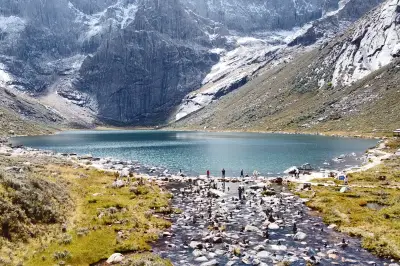
Zhongcha Valley is incredibly beautiful, with misty clouds, green mountains, meadows, connected villages, herds of cattle and sheep, and gradually colored forests... It also contains ancient Tibetan villages with unique and mysterious Tibetan customs and cultural resources.
"Zhongcha" is a Tibetan transliteration; originally it should be "Qiongqia." "Qiong" means "sacred eagle," "qia" means "support, carry," i.e., "the place where the sacred eagle lands." Legend says that King Gesar's mount, a giant sacred eagle, soared the skies and surveyed the universe but could find no place to land except here, where the deity of Mount Baijian could support it. Thus the sacred eagle landed and rested, giving the valley its name, which became famous across the snowy region.
When in Zhongcha Valley, horseback riding is a must. Experience the "horse caravan culture" that has lasted millennia in China. Zhongcha Valley is also an ancient heritage site of horse caravan culture.
Riding up the mountainside, you can get a perfect photo with the snowy peak.
This area is also called "Little Switzerland." The mountain peaks are snow-capped year-round, lush green, with herds of cattle and sheep, and a very complete ecosystem.
We rented our traditional Tibetan-Qiang costumes from one of the shops in Jiuzhaigou Luneng Beauty Town, called Tulu Photography Studio. They have not only Tibetan costumes but also Hanfu (traditional Han clothing). They were quite beautiful.
Then, locals can lead you on horseback up the hillside and to the snowy peaks for photos—it's really stunning.
The local people of Zhongcha Valley are still fairly simple and hospitable.
Originally, no Tibetans lived in Zhongcha Valley. The first inhabitants were the "Dele" family from the ancient Tubo Tibetan royal clan. To escape inter-tribal wars among the Tubo tribes, they traversed jungles, swamps, high mountain lakes, and, led by the sacred eagle, discovered this hidden fertile valley, settling there for hundreds of years. The Dele family, skilled in horse breeding, are the ancestors of today's Ando Tibetans. They brought deep and unique Tibetan culture to Zhongcha Valley.
Zhongcha Valley has snow peaks, forests, and streams all year round. The houses here show the architectural style of northern Sichuan, along with ancient and simple Tibetan villages.
The valley is about 10 km long with an average altitude of over 2,000 m, ending in a chain of snowy peaks, with beautiful scenery.
White pagoda clusters, red houses—antiquity and tranquility linger here.
Blue sky, white clouds, herds of cattle and horses, and simple Tibetan people. Riding horses up the mountain, we reached the small meadow on the slope shown below. Local Tibetan people led the horses as we ascended.
Zhongcha Valley is separated from Jiuzhaigou by one mountain. Locals also call it "Little Jiuzhaigou." These are all Tibetan homes.
If time permits, you can visit a local Tibetan home in Zhongcha Valley for authentic butter tea and high-altitude potatoes—they are incredibly delicious.
Butter tea initially comes with tea, cheese, butter, and sugar served separately in the cup.
Hot tea is poured into the cup, stirred briefly, and drunk—sweet and rich. Then more tea is poured and stirred until everything dissolves.
The Tibetan home is also very beautiful. I really like this color combination—bright but not vulgar, with traditional and regular patterns.
The corridor and door at the entrance are all hand-painted.
In Zhongcha Valley, there is the Jiuzhaigou Forest Earth Pod, a container hotel nestled on the hillside, with rooms scattered on the slope, blending into the forest.
Although it's a container on the hillside, the rooms are of five-star standard and service. The hotel's location in Zhongcha Valley offers the best view of the snowy mountains.
Jiuzhaigou Forest Earth Pod is located on Platform 1 of Zhongcha Valley, Luneng Town, Zhangzha County, Jiuzhaigou County, separated from Jiuzhaigou by only one mountain, less than 8 km from the valley entrance.
The hotel has over 20 independent landscape suites, including 23 guest rooms; one room is the same type used by the celebrity couple Liu Tao and her husband.
You truly sleep in the forest, waking up to green views—the scenery is great, completely different from regular hotel experiences. It's well worth trying.
Sleeping among the mountains and forests, merging with the green mountains, snowy peaks, and colorful forests.
In winter, you can watch the snow from your warm room through the large floor-to-ceiling windows—just thinking about it is beautiful!
Looking directly out the glass window at the scenery feels like viewing a beautiful landscape painting. Waking up to misty mountains and faint snowy peaks opposite—set against the forest and clouds, sleeping in the forest at an altitude of over 2,500 meters.
Fully smart facilities provide an excellent experience. Upon entering, soft music starts playing automatically—jazz and other pleasant tunes carefully selected. There are Evian water, Dahongpao tea, and toiletries of five-star hotel standards... Pull open the curtains for an immersive natural environment.
In addition to toiletries, there are two makeup remover wipes and two face masks.
The room has a humidifier and Bluetooth speaker.
Isolated in a quiet place, backed by green mountains, with distant high peaks. The container-style houses each have large glass windows and a terrace. Opening the curtains in the morning reveals the distant snow mountains. The hotel also provides shuttle service to and from the Jiuzhaigou Scenic Area entrance (advance reservation required).
Breakfast is simple but homely and good. I found this overnight experience excellent.
Jiuzhaigou Luneng Resort not only includes the hotel cluster but all hotels are built around the commercial street called Luneng Beauty Town.
The street gathers non-heritage products from Rangtang—Tibetan carpets, paper, incense, pottery, and embroidery—allowing a glimpse into the exquisite Tibetan culture and the charm of intangible cultural heritage projects.
It also offers dining, entertainment, and cinema options. We had most of our lunches, dinners, and even afternoon coffee here. It's no exaggeration to say it brings together cuisines from around the world.
Jiuzhaigou Luneng Beauty Town also features "Manshou Tibetan Paper" and "Shilun Xiang" (Tibetan incense shop), where you can try making Tibetan paper and incense yourself, deeply experiencing these craft traditions.
In addition, the only Japanese restaurant in all of Jiuzhaigou is on this commercial street—called "Jianggu"—and it's very authentic.
The owner is from Northeast China. One chef specializes in plating, another in teppanyaki.
The restaurant has two floors: the second floor has only private rooms, while the first floor has a main hall with booth seats and private rooms.
The front-of-house manager previously worked at Marriott hotels, and indeed pays great attention to plating. We sat in a private room. There were six of us, and we ordered quite a variety. The plating was excellent—they really know their craft!
The ingredients were surprisingly fresh, service was warm, and drinks and fruit were complimentary.
Restaurant: Jianggu Japanese Cuisine
Address: 1-1, Building 2, Jiuzhaigou Luneng Beauty Town, Langzhai Village, Zhangzha Town, Jiuzhaigou County
Hours: 11:30-14:00, 17:30-22:00
Average cost: CN¥200+/person
Another day, we tried Korean barbecue since this is currently the only Korean BBQ place in Jiuzhaigou.
Luneng has indeed brought city lifestyle and pace to Jiuzhaigou.
The style is very retro Korean—the wall paintings depict ancient Korean lifestyles, but the music playing is contemporary K-pop.
The dishes looked very fresh, and portions were generous. Various seasoned Korean side dishes were also appetizing.
Specialties include seafood scallion pancake, kimchi steamed dumplings, stone pot bibimbap, marinated beef, grass-fed beef tongue, snowflake pork collar, marinated beef ribs, snowflake short ribs, snowflake beef rib fingers, thick-cut pork belly...
Restaurant: Meihui Korean BBQ
Address: Luneng Beauty Town, Langzhai Village, Zhangzha Town, Jiuzhaigou County
Hours: 11:30-14:00, 17:00-22:00
While shopping, we noticed this very American-style restaurant. As it turned out, this restaurant has an impressive background. I never expected to find such a famous chain restaurant in Jiuzhaigou.
Hard Rock Cafe is a well-known themed restaurant chain. Its Chinese name translates to "Rock" or "Roll" restaurant. The first Hard Rock Cafe was opened in London in 1971 by two American youths, Isaac Tigrett and Peter Morton. The globally renowned Hard Rock brand was personally designed by the famous designer Alan Aldridge, who was once the official designer for The Beatles. Simply put, this restaurant is all about rock and roll.
This Hard Rock Cafe in Jiuzhaigou serves American fast food and also features live band performances. Their Legendary Burger is a signature dish—super thick, enough for two people to share; otherwise, after finishing this burger you'll be completely full!
The live band mainly performed English songs, fitting the brand's origin.
What's most valuable is that every Hard Rock Cafe contains many precious stage costumes worn by rock band stars, signed posters, and photos. Jiuzhaigou is no exception—clothes worn by celebrities during performances are displayed in glass cabinets, along with signed photos and posters.
The details throughout the restaurant are also very "rock"—even the door handles are guitar-shaped.
The manager of Jiuzhaigou Hard Rock Cafe is a beautiful woman with a pure Beijing accent. She has a very distinct personality and deep knowledge of rock music. Her introduction of the in-house exhibits reveals a genuine love for rock that is evident in her speech.
Besides the dining area, there is a small co-branded merchandise shop where you can buy athlete collaboration clothing. The brand's logo T-shirts are quite popular in the US.
This purple outfit was the exaggerated purple feathered stage costume worn by singer Wu Mochou during a performance.
I particularly enjoy seeing these cultural and historical items.
In Jiuzhaigou, there is a place to experience Aru Zang (Tibetan herbal bath) and Shilun Tibetan Tuina (massage), called Aru Zang Snowland Wellness Baolin. This establishment mainly offers Tibetan herbal baths, massage, Tuina, scraping therapy, and other wellness services. The entrance is stunning—exquisitely carved and painted in traditional Tibetan style, hand-painted by artists from the Thangka Training Institute.
The service staff all come from the Rang Bala Jonang Tibetan Medicine Training Institute, each having studied Tibetan medicine, Chinese medicine, and Daoist medicine for nearly 10 years, with rich medical experience. Before the herbal bath, a pulse diagnosis is performed to understand your body condition, and then the herbal bath ingredients are tailored accordingly.
Doctors write prescriptions with brush pens.
Tibetan herbal bath is a UNESCO Intangible Cultural Heritage, one of the external therapies in Tibetan medicine. Through the bath, the medicine directly acts on the skin, acupuncture points, etc., opening the pores, dilating blood vessels, and accelerating blood circulation. The medicine is absorbed through the skin into the meridians and distributed throughout the body. Tibetan herbal bath has now formed a specialized treatment for health preservation. It has remarkable effects on improving circulation of Qi and blood in meridians, enhancing metabolism, regulating endocrine, as well as treating joint stiffness, rheumatism, rheumatoid arthritis, gout, ankylosing spondylitis, sciatica, skin diseases, gynecological diseases, and circulatory system diseases.
After pulse diagnosis, you enter the room, shower in the private bathroom, and then begin the entire process. There are 9 steps: 1. Tea ceremony: first drink Dalehua tea (Dale flower tea) to moisten the lungs. 2. Incense ceremony: sprinkle purification water and purify the air. 3. Shower: simple rinse in the private shower. 4. Blessing bowl: listen to music to calm the mind. 5. Diamond hammer to open acupoints. 6. Enter the wooden bath barrel for Tibetan herbal bath. 7. Tuina massage. 8. Diamond stick to seal acupoints. 9. Herbal meal.
Tea tasting: Dalehua tea, harvested from high mountain cliffs, rare and precious.
Teacups are original designs.
The young therapists (brothers and sisters) providing herbal bath and Tuina have studied Tibetan medicine for seven to eight years at the Rang Bala Non-Heritage Training Institute founded by Principal Jianyang Lezhu. They are all in their early twenties, totaling over 20 professional therapists. Some have also studied Chinese medicine in Shanghai and Daoist medicine in Laoshan. They must pass examinations by Tibetan medicine masters; pharmacology, Tuina, cupping, and acupuncture are compulsory subjects. On the second floor, there are hanging paintings made of kesi (silk tapestry), known as the "saint of weaving."
The Tibetan medicinal herbs are natural, made into the Five Nectar Decoction. The ingredients like sweet flag were hand-picked by these Tibetan therapists from high-altitude mountains at 3,000-4,000 meters.
The Tuina techniques combine different methods and rituals from Tibetan, Chinese, and Daoist medicine (including the blessing bell, diamond fist to open acupoints, four-wheel sound contemplation, wisdom diamond massage, and diamond stick to close acupoints).
The venue has two floors, with quality details throughout: elegant paintings, thangka appliqué, handmade crafts, and exquisite Tibetan-style decoration.
The Aru Zang brand was founded by the Rang Bala Jonang Tibetan Medicine Training Institute in collaboration with internationally renowned skincare experts. The brand includes dozens of products such as shampoo, face masks, essential oils, and skincare.
The best way to understand a city is to visit its local museum. At the entrance of Jiuzhaigou Luneng Beauty Town is the Jiuzhaigou Tibetan-Qiang Intangible Cultural Heritage Museum.
The entire exhibition hall is very helpful for understanding the culture and history of the Tibetan and Qiang peoples.
It's more interesting to have a guide explain as you walk through.
"Tibetan-Qiang weaving and embroidery" is a collective term for "Tibetan weaving, cross-stitch, and embroidery" and "Qiang embroidery." Both are national-level intangible cultural heritage representative projects, among the most vivid and dynamic cultural heritages closely related to Tibetan and Qiang daily life, capable of dialogue with modern society. They have strong ethnic and regional characteristics, hailed as the "Pearl of Tibetan-Qiang Art."
Exhibition of Tibetan weaving techniques and Qiang embroidery works.
One area is dedicated to the history of Tibetan medicine. Tibetan medicine has formed a unique medical system based on extensive absorption and integration of traditional Chinese medicine, Indian medicine, and Islamic medicine, through long-term practice. It has a history of thousands of years and is one of China's relatively complete and influential ethnic medicines.
"The Four Tantras" is the earliest extant medical monograph of the Tibetans. It is said to be authored by Jebuxisi (Tibetan: omitted), son of Shenrab Miwo, the founder of the Bön religion, and was completed in 1999 BCE.
This is the museum's treasure: the Colored Sand Mandala. The creation of colored sand mandalas originates from the traditional art of Tashilhunpo Monastery in Shigatse, Tibet Autonomous Region, and is a national intangible cultural heritage. Mandalas originated from Indian Buddhist Esoteric Buddhism and are one of the objects of veneration in Tibetan Buddhist esoteric practice. They are built with colored sand grains according to strict proportions, structures, and content, starting from the center after outlining on a platform, gradually expanding outward. Besides sand mandalas, there are also hand-painted, wood-carved, and other forms.
This mandala made from ground gemstones meticulously crafted over several months is truly beautiful, very large, and breathtaking.
Thangka (scroll painting) is a unique artwork of Tibet. It can be created using various techniques such as colored painting, embroidery, and appliqué. Mineral and plant pigments mixed with animal glue and ox bile are used to maintain bright colors that do not fade over time. The works are bordered with brocade and fitted with wooden rollers at top and bottom for hanging, worship, and teaching. Subjects include Buddhas, Bodhisattvas, female deities, Dharma-protecting Vajras, eminent monks, and patriarch biographies; modern works also reflect folk customs. They are usually square, ranging from one foot to ten or more feet per side.
In the future, the Jiuzhaigou Tibetan-Qiang Intangible Cultural Heritage Museum will also offer hands-on experiences, such as Tibetan-Qiang weaving and embroidery.
Green No.7 Paradise is located on the hill behind the Hilton Hotel, on Platform 1 of Zhongcha Village. It's an outdoor adventure park under the snow mountain, suitable for both adults and children.
Current ticket price: CN¥88 for adults, CN¥58 for children. The park spans three altitude platforms, themed around pristine scenery and nature exploration, providing a luxurious and private exploration experience integrated with nature.
Here, I finally achieved my little "bungee jumping" goal—though it was a mini short-distance version.
The park includes 12 experiential sub-projects: forest activities, rope climbing, expansion training, high-altitude mountain crossing exploration, high-altitude delta wing, zip line, and more.
All-terrain off-road motorbike: CN¥100 for 2 laps, CN¥128 for single seat 2 laps, CN¥168 for double seat 2 laps.
Since we were already in Jiuzhaigou, we had to visit the main scenic area. After all, it was my first time; the psychology of "since I'm here" was very strong, even though I had already seen countless beautiful photos of Jiuzhaigou online. Jiuzhaigou mainly consists of three main ditches in a Y-shape: Zawa Gully, Rize Gully, and Shuzheng Gully. The primeval forest, Five Flower Sea, and Pearl Shoal Waterfall are must-sees.
Before entering the scenic area, a COVID-19 test within 48 hours was required. We had it done the day before at a local hospital in Jiuzhaigou. The current ticket price for Jiuzhaigou is CN¥280, which includes the shuttle bus inside the scenic area. Unless you belong to a special category (children, elderly, disabled, or other special occupations), you must buy the full-price ticket including the shuttle: CN¥280. Only those special groups are eligible to pay just CN¥90 for the shuttle and get free admission.
The shuttle buses stop at all major scenic spots, so you can get on and off at any time.
The scenic area includes: primeval forest, Grass Lake, Swan Lake, Arrow Bamboo Lake, Panda Lake, Panda Lake Waterfall, Five Flower Sea, Pearl Shoal, Pearl Shoal Waterfall, Mirror Lake, Nuorilang Central Station, Long Lake, Five-Color Pond, Nuorilang Waterfall, Rhinoceros Lake, Tiger Lake, Shuzheng Waterfall, Shuzheng Mill, Shuzheng Cluster of Lakes, Shuzheng Folk Culture Village, Crouching Dragon Lake, Spark Lake, and Bonsai Shoal.
Whether to visit every spot depends on personal preference. We skipped the primeval forest because it's at the top of the mountain and requires a lot of walking. I came to Jiuzhaigou mainly for the water.
Jiuzhaigou is a UNESCO World Natural Heritage Site, a national key scenic spot, a National AAAAA Tourist Attraction, a national nature reserve, a national geopark, a UNESCO Biosphere Reserve, and China's first nature reserve primarily aimed at protecting natural scenery.
Although we encountered overcast weather when we went to Jiuzhaigou, the water was still truly beautiful—pure and crystal clear blue.
If you want to visit the primeval forest, you should start very early to see all the classic spots one by one and exit in the afternoon. If you skip the forest, half a day is enough.
There are very few dining options inside the Jiuzhaigou scenic area. Only small shops and vending machines selling drinks, snacks, dry food, and instant noodles.