Land of Abundance: So Happy I Still Think of Shu (Part 1)
I have been to Sichuan at least five or six times, occasionally for tourism, but mostly for work, and I hardly did any sightseeing. The places I visited were mostly near Chengdu, including Dujiangyan, post-earthquake Wenchuan, and within the city: Kuanzhai Alley, Chunxi Road, Wuhou Shrine, Jinxi, etc. I also passed through Songpan, Ruoergai, and went to Qinghai. Among these, there was an important reason: the landscapes of Jiuzhaigou were the most perfect existence in my mind, so I always hesitated to visit as a tourist, fearing that after seeing Jiuzhaigou, I would lose interest in all other landscapes in China. This also led to a mentality of trying to postpone my Sichuan trip as much as possible.
This trip was exclusively for tourism, without other concerns. Since all journeys in Sichuan radiate outward from Chengdu as the center, the routes are long and mostly mountainous. For safety, I opted for a private group with a rented vehicle. I selected the attractions myself, then requested quotes from several travel agencies specializing in customized tours. I contacted four agencies, communicated back and forth many times, adjusted the itinerary several times, and finally chose one. I also gave up the route passing through Qingmuchuan in Hanzhong, Shaanxi, until the itinerary was finalized.
There were 13 people on this trip, most of them travel companions from many previous trips.
We set off in the evening, drove for two hours to Nanjing Lukou International Airport, and then after a little over two hours, arrived at Chengdu Shuangliu International Airport.
The contracted travel agency was very responsible. They picked us up and took us to our accommodation. We were informed to depart at six the next morning, but I negotiated to delay it by half an hour so everyone could sleep a bit longer.
Basically on schedule, the agency provided breakfast, and we could eat directly in the car after washing up.
The young guide was not wrong: less than 400 kilometers, but the 19-seat minibus took over seven hours, with a stop at an unknown Qiang village for lunch and rest. We only arrived at Huanglong near four in the afternoon.
Huanglong Scenic Area, located in Songpan County, Aba Tibetan and Qiang Autonomous Prefecture, is the only well-preserved high-altitude wetland in China, situated on a gradually rising mountain ridge from south to north. The total area is 700 square kilometers, with altitudes ranging from 1700 to 5588 meters. The core area is dotted with over 3,000 colored pools. The main landscape features are exquisitely structured and richly colored travertine deposits (calc-sinter). It consists of Huanglong Valley, Danyun Gorge, Muni Valley, Xuebaoding, the Red Army Long March Monument Garden, etc. In 1992, Huanglong Scenic Area was inscribed on the World Natural Heritage List. It is a national AAAAA-level tourist attraction and a key national scenic area.
We took the cable car up the mountain. At Wanglongping (Dragon Viewing Terrace), we looked down at the full view of Huanglong: the sky was overcast, there was snow on the peaks, and the entire Huanglong scenic area lay between the two mountains.
According to the introduction, the total area is 21,000 square meters, with 693 colored pools of various sizes, at an altitude of 3,576 meters. It is the world's largest, most numerous, and highest-altitude open-air travertine pool group. The colors vary in intensity, creating a riot of hues.
When we left the Five-Color Pond, snow fell from occasional flurries to a full-blown dance, transforming the emerald fairyland into a silver-clad world.
Since it was April, the water level was severely low, and many pools along the way were dry. But one could imagine that when there is water, they look much like the Five-Color Pond.
Above is the Golden Sand Spread Ground. Under the snow cover, there was a cave called Xishen Cave (Body-Washing Cave).
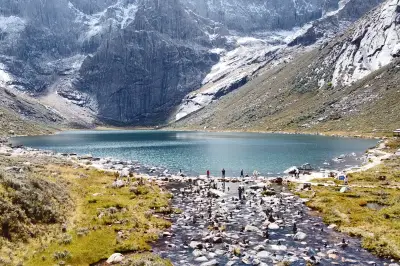
On the mountain it was winter; at the foot of the mountain it was spring. After leaving the scenic area, we stayed in Chuanzhushi Town. The photo shows the distant mountain scenery captured on the way.
Chuanzhushi is a town under Songpan County, Aba Prefecture. It is a transportation hub in western Sichuan: northwest leads to Ruoergai Grassland and Qinghai, northeast to Jiuzhaigou, south to Chengdu. The altitude here is 2,980 meters, known as the "Pearl of Western Sichuan." The Red Army Long March also passed through here. Legend has it that Li Bing contributed greatly to taming the Minjiang River, and a tributary of the Minjiang flows here. The locals revered Li Bing as their master and built a temple to commemorate him, hence the name Chuanzhushi (Chuan Master Temple).
After breakfast, we took about two hours to reach the most longed-for and sacred destination: Jiuzhaigou Scenic Area.
Jiuzhaigou is actually a large tributary valley at the headwaters of the Baishui River, which is a tributary of the Jialing River in the Yangtze River system. The total area is 65,074.7 hectares. It contains four scenic areas: Shuzheng Valley, Zechawa Valley, Rize Valley, and Zharu Valley, which are further divided into many smaller attractions. The main landscape features are plateau travertine lake groups, travertine waterfall groups, and travertine shoals. The forest coverage exceeds 80%. The water scenery is grand in scale, diverse in type, numerous in number, beautiful in form, and excellent in environment.
For thousands of years, Jiuzhaigou remained hidden among the towering mountains of the northwestern Sichuan Plateau, with minimal human activity. The Tibetan people living here were self-sufficient and almost completely isolated from the outside world. In 1975, a working group from the Ministry of Agriculture, Forestry and Fisheries conducted a comprehensive survey of Jiuzhaigou and concluded: "Jiuzhaigou not only contains rich and precious animal and plant resources but is also one of the world's rare beautiful scenic areas." The same year, forestry expert Professor Wu Zhonglun conducted a more thorough investigation. Standing on the site, he was deeply moved: "I have been to several countries in Europe and America, and I have never seen such wonderfully beautiful natural scenery. It must be well protected." He immediately informed the Provincial Forestry Department and wrote to the Sichuan Provincial Government. The Provincial Forestry Department promptly sent a directive to Nanping County Forestry Bureau: "Only trees beyond 200 meters in Zechawa and Rize valleys of Jiuzhaigou may be logged." In 1978, State Council Document No. 34 designated Jiuzhaigou as a natural scenic protection area, with a protected area of 620 square kilometers. In 1979, the two logging camps stationed in Jiuzhaigou were relocated. The same year, according to the "Notice on Strengthening the Construction of Nature Reserves" from the Sichuan Provincial Revolutionary Committee, the Nanping County Jiuzhaigou Nature Reserve Management Office was established. In 1984, State Council Document No. 136 listed Jiuzhaigou as one of the first batch of national key scenic spots, and the Nanping County Jiuzhaigou Scenic Area Management Bureau was established. Jiuzhaigou officially opened to the public. Eventually, this remote and little-known Jiuzhaigou scenic area gained fame both at home and abroad.
In 2017, a 7.0-magnitude earthquake struck Aba Prefecture, causing some damage to the Jiuzhaigou scenic area. It was only partially open afterward until September 2021, when the entire area was fully reopened to the public.
We took an electric sightseeing car to Shuzheng Valley and started walking upstream to enjoy the scenery.
Along the way, Spark Lake, Sleeping Dragon Lake, Tiger Lake, and others, layer upon layer, were incredibly beautiful.
Flowing water was always full of vitality and life.
Vast forests, towering mountains.
Rhinoceros Lake was as smooth as a mirror, with vibrant colors.
Animals and plants are born here, grow here, and die here, letting us feel the harmonious coexistence of nature.
It was a filming location for the 1986 version of "Journey to the West." The scene of the four pilgrims walking on the waterfall left a deep impression.
Here are rocks that fell during the earthquake on August 8, 2017.
This is a barrier lake (landslide-dammed lake), the highest, deepest, and largest-capacity lake in Jiuzhaigou, with no outlet. All water in Jiuzhaigou comes from here, seeping out through underground rock crevices. Because it never overflows in summer and never dries up in winter, it is called a treasure gourd that can never be filled and never leaks.
Five-Color Pond is the smallest but most colorful lake in Jiuzhaigou.
Strolling through, it felt like being in a fairyland.
One lake after another formed waterfalls of various sizes, some majestic, some delicate.
Green trees and blue water complemented each other, creating a beautiful fairy-tale world.
Huang Xiaoming's version of "The Return of the Condor Heroes" was filmed in Jiuzhaigou.
The water was crystal clear, with aquatic plants swaying with the current. Reflecting the vitality of nature, it was awe-inspiring! My heart was stirred!
We stayed overnight near Zharu Temple on the north side of the scenic area. We watched a cultural performance called "Eternal Love of Jiuzhaigou."
The large-scale song and dance performance "Eternal Love of Jiuzhaigou" is divided into scenes: "Legend of Jiuzhaigou," "Ancient Qiang War Song," "Han-Tibetan Marriage Alliance," "Boundless Love," "Heaven and Earth Auspiciousness," etc. The beautiful and mysterious Tibetan and Qiang songs and dances take you on a journey through time. The magnificent Tang Dynasty palace presents the grand feat of Princess Wencheng's marriage to the Tibetan king. 5D live scenes and high-tech means reproduce the horrific scene of the May 12 Wenchuan earthquake in Aba Prefecture: mountains collapsing, houses falling, the entire theater and thousands of seats shaking violently, and 3,000 cubic meters of floodwater pouring down like a tidal wave... Real stories and touching scenes show the great love of the Chinese people united in earthquake relief. In the one-hour performance, 300 actors, a 360-degree panoramic stage, and tens of thousands of stage machinery interact with the audience in all directions. Using high-tech sound, light, electricity, and spatial creativity, it completely breaks the boundaries of art forms—a visual feast that shakes the soul!
Entrance to the Tibetan-Qiang Ancient City
Inside the city, there are constructed landscapes featuring local characteristics: the Tea Horse Road, Tang-Tibet Square, Semo Goddess, Tibetan Market, Tibetan-Qiang Watchtowers, etc.
The hospitable Qiang people are known as "the nation on the clouds." Regardless of age or gender, if they can walk, they can dance; if they can speak, they can sing.
In 641 AD, Princess Wencheng journeyed to Tibet for a political marriage—a historically significant event. At that time, the ambitious Songtsen Gampo married the Tang princess in the Jiuzhaigou area. The entourage accompanying her to Tibet included hundreds of people, including experts and scholars in Tang architecture, medicine, agriculture, weaving, etc. Han culture spread to Tubo (Tibet), promoting peace and prosperity in the Tibetan region, writing a glorious chapter in ethnic integration.
After the earthquake disaster, peaceful Buddhist chants soothed people's hearts. A huge Tibetan white stupa slowly descended from the sky, and on both sides of the moving audience seats, lotus-shaped lifting platforms rose symbolizing good fortune. Lamas holding prayer wheels chanted prayers. Looking up at the theater ceiling, colorful prayer flags fluttered in the air. The performance ended amid auspicious sounds and applause.
For dinner, we had a special Tibetan-style meal. It had a unique flavor.
The Jiuzhaigou trip finally fulfilled my dream, and I was truly awed by the natural beauty here! I do not regret the earthquake damage, because before the earthquake it was one kind of nature, and after the earthquake it is another kind of nature. Its mountains, waters, forests, vitality, and natural charm have not diminished at all. Of course, I went during the dry season, but apart from the Five-Color Pond, the other lakes were still full of vitality. This probably has much to do with the inexhaustible water of Long Lake and the structure of water seeping through rock crevices. I also watched the grand performance "Eternal Love of Jiuzhaigou," which left me very satisfied, with a feeling of contentment, a physical and mental relaxation, and a pleasant release.