Dreamlike Jiuzhaigou – A Nine-Day Tour of Jiuzhaigou Valley
Located in the transition zone from the Qinghai-Tibet Plateau to the Sichuan Basin, Jiuzhaigou is renowned for its colorful lakes and magnificent waterfalls. On August 8, 2017, a 7.0-magnitude earthquake struck Jiuzhaigou County in Aba Prefecture, Sichuan, damaging the scenic area. After several years of restoration, Jiuzhaigou has regained its beauty. After the peak summer season, we decided to visit Jiuzhaigou after the earthquake. For this trip, we planned to first visit the Sanxingdui Museum in Guanghan, then take a bus to Jiuzhaigou, so we chose Mianyang, which has more train services to Guanghan, as the first stop of our journey.
Total cost (for 2 people): 11,910.58 yuan, including:
Transportation (including chartered car) 4,678.00 yuan, Accommodation 1,948.24 yuan, Tickets (including scenic area sightseeing buses, cable cars, etc.) 2,314.00 yuan, Shopping, meals, local transportation and miscellaneous 2,970.34 yuan.
We took a morning flight and landed at Mianyang Nanjiao Airport at 9:45. We took a taxi to the pre-booked hotel. After a short rest and lunch, we visited Fule Mountain Park in Mianyang.
Fule Mountain Scenic Area is located 2 km east of the urban area of Mianyang City, Sichuan Province, on the southern section of the ancient "Shudao of Jianmen". Formerly known as Dongshan (East Mountain) or Qishan (Flag Mountain), it features a beautiful environment, numerous historical relics, and a blend of Three Kingdoms ruins with landscape gardens. There are gardens within gardens, and views change with every step. It combines the luxurious style of imperial gardens with the rustic charm of natural landscapes, earning it the reputation of "First Mountain of Mianzhou."
Fule Mountain Park
Day 2
At 7:15 a.m., we took a bullet train from Mianyang Station to Guanghan North Station. After exiting, we transferred to a bus and arrived at the Sanxingdui Museum a little after 8 a.m.
The Sanxingdui ruins date back 3,000 to 5,000 years. They are the largest, longest-lasting, and culturally richest ancient city, ancient kingdom, and ancient Shu cultural site discovered in the southwestern region. Known as one of the greatest archaeological discoveries of the 20th century, it shows that the Yangtze River Basin, like the Yellow River Basin, is a cradle of Chinese civilization and is hailed as the "Source of the Yangtze River Civilization."
Located on the northeastern corner of the Sanxingdui site, on the banks of the Yazi River west of the historic city of Guanghan, the Sanxingdui Museum integrates artifact collection and preservation, academic research, and social education. It is a modern thematic site museum in China. Covering about 530 mu (approximately 35.3 hectares), the museum opened in October 1997. It houses and displays over a thousand precious artifacts unearthed from the Sanxingdui site and its No.1 and No.2 Shang Dynasty sacrificial pits, including bronzes, jade and stone artifacts, gold artifacts, pottery, and bone artifacts.
Sanxingdui artifacts are valuable human cultural heritage. Among China's vast and magnificent collection of cultural relics, they are among the most historically, scientifically, and artistically valuable and most visually appealing groups. Among these mysterious treasures of the ancient Shu kingdom, there are many bizarre and unique bronze shapes, including a 2.62-meter-tall bronze standing figure, a 1.38-meter-wide bronze mask, and a 3.96-meter-tall bronze divine tree, all unparalleled masterpieces. The gold artifacts, represented by the gleaming gold staff, and the jade and stone artifacts, such as the richly decorated jade tablet (bian zhang), are also unprecedented rare treasures.
Sanxingdui Museum
Sanxingdui Museum
Sanxingdui Museum
Sanxingdui Museum
Sanxingdui Museum
Sanxingdui Museum
Sanxingdui Museum
Sanxingdui Museum
Sanxingdui Museum
Sanxingdui Museum
Sanxingdui Museum
Sanxingdui Museum
Sanxingdui Museum
Sanxingdui Museum
Sanxingdui Museum
Sanxingdui Museum
Sanxingdui Museum
Sanxingdui Museum
Sanxingdui Museum
Sanxingdui Museum
We spent about four hours touring the museum. Since it was still early, we then visited Fanghu Park.
Fanghu Park is located in the southwest corner of Luocheng Street, Guanghan City. It was built by Fang Guan, a famous prime minister of the Tang Dynasty, when he was demoted to be the governor of Hanzhou. It is known as the "Pearl of Western Sichuan." The western gate is the crenellated gate of the ancient Luocheng city, with 500 meters of crenellations and a three-story gate tower, towering and majestic, with golden tiles shining and eaves and pillars flowing with vermilion, solemn and magnificent. The park is dotted with antique attractions, featuring both the delicate features of Suzhou-style gardens and the ancient charm of Bashu gardens.
After leaving Fanghu Park, we took a bus to Guanghan North Station and caught the 18:17 bullet train back to Mianyang.
Day 3
Today we are heading to Jiuzhaigou. Currently, the expressway from Mianyang to Jiuzhaigou and the high-speed railway from Chengdu to Jiuzhaigou are both under construction, so the only option is to take a bus. After breakfast at the hotel, we took a taxi to Mianyang Pingzheng Bus Station. We departed on time at 9:30, and after nearly 8 hours of driving, we checked into a hotel near the Jiuzhaigou scenic area in the evening.
Day 4
The hotel we stayed in was not far from the Jiuzhaigou scenic area. After breakfast at the hotel, we walked about ten minutes to the main entrance of the scenic area.
Jiuzhaigou is a mountain valley over 50 km deep, with an altitude above 2,000 meters. It gets its name from the nine Tibetan villages (also called Heyao Jiuzhai) located in the valley, such as Shuzheng, Heye, and Zechawa. Most of the valley is covered by forests, with many lakes, waterfalls, and travertine streams. Water is the main feature of Jiuzhaigou's landscape. The crystal-clear green streams run through the forests and shoals like necklaces, and the colorful lakes and magnificent waterfalls are a feast for the eyes. In the distance, snow-capped peaks stand tall against the sky, covered in white snow all year round. Combined with the cultural landscape of Tibetan wooden houses, prayer flags on drying racks, plank bridges, mills, traditional customs, and myths, it is known as a "fairy tale world."
Jiuzhaigou National Nature Reserve is located in Jiuzhaigou County, Aba Tibetan and Qiang Autonomous Prefecture, Sichuan Province. It is the first nature reserve in China established primarily to protect natural scenery, and it is a famous scenic area and a national model of civilized scenic tourism. It has been included in the UNESCO World Natural Heritage List and the "Man and Biosphere" protection network.
The Jiuzhaigou Scenic Area is distributed in a "Y" shape, with Shuzheng Gully as the lower branch, Zechawa Gully as the left branch, and Rize Gully as the right branch. The scenic area's eco-friendly sightseeing buses go from the entrance to Nuorilang Service Center, and then according to the dispatch, they head either to Long Lake in Zechawa Gully or to Primeval Forest in Rize Gully. On the return trip, visitors can get off at various attractions.
We planned to spend two days in Jiuzhaigou. Today, our first stop on the eco-friendly sightseeing bus was Long Lake in Zechawa Gully, so our Jiuzhaigou tour started from Long Lake.
Zechawa Gully is the left branch of the "Y" shape of Jiuzhaigou. From Nuorilang Service Center to Long Lake, it is nearly 18 km long, with beautiful scenery. It is the highest-altitude route in Jiuzhaigou. The attractions are concentrated at the end of the gully, mainly including Seasonal Sea, Five Flower Pond, and Long Lake.
Long Lake is at an altitude of 3,150 meters. It is the longest lake in Jiuzhaigou, about 5 km long, appearing dark blue and shaped like an "S." Surrounded by layered green mountains and dense forests, the water is like a mirror, with majestic snow peaks bathed in blue sky and white clouds, magnificent and spectacular. Long Lake can be considered the mother of all lakes in Jiuzhaigou, as it has no outlet; water is discharged only through evaporation and underground rivers, which provide an important water source for other lakes.
About one kilometer downhill from Long Lake is the Five Flower Pond.
Five Flower Pond is located in the southern section of Zechawa Gully, north of Long Lake. It is known for its beauty, diversity, purity, and transparency. It is the smallest and most colorful pond in Jiuzhaigou. The water is clear and transparent, with a deep blue surface. Through the water, you can clearly see the patterns of the rocks at the bottom. The aquatic plants growing in the water have different chlorophyll levels, which, combined with the calcium carbonate-rich lake water, produce different colors. Under the sunlight, the mottled light creates a colorful scene.
From Five Flower Pond, we took a sightseeing bus back to Nuorilang Service Center. After a short rest, we walked to Nuorilang Waterfall and began touring the attractions of Shuzheng Gully.
Shuzheng Gully is the main gully of Jiuzhaigou and the gateway to its beautiful scenery. It is 14 km long and contains more than 40 lakes, accounting for about 40% of all lakes in Jiuzhaigou. Known as the epitome of Jiuzhaigou, it features mysterious lakes, colorful shoals, clusters of lakes dotted with ancient mills and plank bridges, and magnificent waterfalls that leave visitors in awe of nature's wonders.
Nuorilang Waterfall is at an altitude of 2,365 meters, with a width of 270 meters and a height of 24.5 meters. It is one of China's large travertine waterfalls and the widest waterfall in China. In Tibetan, "Nuorilang" means magnificent and spectacular. The waterfall cascades in multiple tiers, with a 140-meter-wide water curtain flying out from between the mountains, plunging down a hundred-foot cliff, forming a rare forest waterfall. Opposite the waterfall, there is an observation deck. Standing on the deck, you can get a panoramic view of the waterfall. The 300-meter falling water, set against the clouds, creates a magnificent scene. Many films and TV shows have been shot here; the ending credits of the 1986 TV series "Journey to the West" were filmed at this location.
Nuorilang Waterfall is a must-see spot in Jiuzhaigou, with many people. After playing there for a while, we took a bus to Rhinoceros Lake.
Rhinoceros Lake is at an altitude of 2,301 meters. It is a vast body of water and the second largest lake in Jiuzhaigou. According to legend, a critically ill eminent monk riding a rhinoceros came here, drank water from the sacred spring by the lake, and was miraculously cured. He then left his beloved rhinoceros here, hence the name. In spring and summer, the lake water is emerald green; in clear autumn weather, the colorful autumn scenery reflected in the lake is stunningly beautiful. Especially the large area of blue water in the middle is intoxicating and makes visitors linger.
About a two-minute bus ride from Rhinoceros Lake is Tiger Lake.
Tiger Lake is at an altitude of 2,298 meters. The lake water appears blue due to travertine, transitioning from light blue to sapphire blue to deep blue, with uniform color changes, very beautiful. Every late autumn, the trees on the lakeside hills display a riot of colors, reflected in the clear lake water, creating a mottled pattern resembling tiger stripes.
From Tiger Lake, we took a bus and soon arrived at Shuzheng Village.
Shuzheng Village is a Tibetan and Qiang settlement located in Shuzheng Gully. Behind the village stands Mount Dage, at an altitude of 4,200 meters, facing the Shuzheng Lakes. Inside the village, there is the Nine Treasures Lotus Stupa, which represents the unity, peace, and happiness of the nine Tibetan villages.
Shuzheng Waterfall is located by the road in front of Shuzheng Village, at an altitude of 2,295 meters. It is the first waterfall seen when entering the gully and the smallest of Jiuzhaigou's four major waterfalls. The waterfall forms a convex arc, composed of many cascading waterfalls connected end to end, creating a multi-level rounded waterfall.
Shuzheng Lakes are at altitudes between 2,187 and 2,280 meters. The terrain is formed by superimposing debris flow deposits on the valley floor, further cemented by travertine deposition, creating 19 lakes that cascade layer by layer along the gully. On the dikes, clumps of plateau-specific shrubs stand tall, rooted in the water, defying the torrent, enduring the impact of flowing water for years without falling or rotting. They form a unique plant community and a rare natural wonder rarely seen in the world. Forests, lakes, and small waterfalls interlace, set in the deep mountains and valleys, connected by green trees and silver small waterfalls, like a beautiful emerald necklace adorning Shuzheng Village, presenting a peculiar landscape of "trees growing in water, water flowing through forests, and people walking in a painting."
Walking along the boardwalk from Shuzheng Lakes for over 900 meters, a tranquil lake appears before you—this is Crouching Dragon Lake.
Crouching Dragon Lake is at an altitude of 2,220 meters. At the bottom, there is a milky-yellow travertine dike shaped like a crouching dragon, lifelike. The lake surface is calm and serene, like a smooth, crystal-clear sapphire. Surrounded by various flowers and trees, it is lush green in spring and summer. The blue-green water of the lake becomes even more intense, intoxicating the heart. When autumn wind rises, red leaves and green trees are reflected in the lake and mountains, creating a beautiful scene.
Deadwood and broken branches that have been immersed in water for a long time, under the action of travertine, form beautiful "tree corals."
Continuing along the forest boardwalk, accompanied by clear lake water and beautiful "tree corals" at the bottom, we soon arrived at Spark Lake.
Spark Lake was formed by debris flow accumulation, at an altitude of 2,211 meters. The lake is surrounded by dense forests. The lake, nestled in clusters of green, is as calm as a mirror, like a crystal-clear emerald plate. Sunlight slants across the lake surface, shimmering like sparks. Wildflowers bloom around, in clusters, with colorful petals and crystal-clear dewdrops glistening, complementing the sparks in the lake, creating endless charm.
100 meters from Spark Lake is Double Dragon Lake.
Double Dragon Lake is at an altitude of 2,200 meters, surrounded by countless tall trees. Many deadwood and broken branches have settled at the bottom. Through the crystal-clear lake water, two ribbon-like biological travertine dikes can be seen hidden underwater. The upper part of the dikes is travertine, the lower part is glacial moraine, resembling two dragons, seemingly still or moving. On the indigo-blue water surface, clusters of delicate, verdant plants sprout from the deep yellow deadwood—a sign of deadwood rejuvenation, creating a vibrant scene that makes one feel the power of nature and the traces of history.
From Double Dragon Lake, we took a bus to Bonsai Shoal.
Bonsai Shoal, also called "Bonsai Lake," called "Jia Zhu Cuo" in Tibetan, is the first shoal landscape encountered when entering Jiuzhaigou. The travertine shoal has a gentle slope, with clear river water. On the milky-white travertine shoal grow various plants, with intertwined roots, each tree forming a unique scene, creating a thousand natural bonsais. These bonsais are completely natural, without artificial manipulation or decoration, but their unparalleled harmony and natural beauty demonstrate a higher level of aesthetic appreciation.
After a day of playing, we were a bit tired. After taking some photos at Bonsai Shoal, we took a bus back to the main entrance of the scenic area, ending our day.
Day 5
Yesterday we toured Zechawa Gully and Shuzheng Gully. Today we continued to explore Rize Gully of Jiuzhaigou.
Rize Gully scenic line is 18 km long, between Nuorilang and Primeval Forest. It is the highlight of the Jiuzhaigou scenic line, extremely beautiful and varied, and the climax of Jiuzhaigou's landscape. Rize Gully has numerous attractions: Mirror Lake, Pearl Shoal Waterfall, Pearl Shoal, Peacock River, Five Flower Lake, Panda Lake, Arrow Bamboo Lake, Swan Lake, Grass Lake, etc.
Here, some lakes are colorful like ever-changing kaleidoscopes; some are pristine and natural like entering a fairyland; some are deep and serene like enchanting mirrors. There are also the waterfall with the greatest drop, treasure-basin-like shoals, and ancient towering forests. The various attractions are arranged in order, alternating in height and connecting naturally, giving a strong aesthetic feeling and stirring people deeply.
After entering the scenic area, the sightseeing bus we took happened to be heading toward Primeval Forest. The bus arrived at Arrow Bamboo Lake, where most visitors started their tour, but we continued on the bus to the end of Rize Gully—Primeval Forest.
Primeval Forest is at the southernmost end of Jiuzhaigou, at an altitude of 2,930 meters. The vegetation is mainly various fir and spruce trees. The air is fresh, making it a natural oxygen bar.
After spending some time in the Primeval Forest, we walked downhill along the boardwalk. Not far along, a peak appeared beside the boardwalk, pointing to the sky like a sword—this is Sword Rock.
Sword Rock Hanging Waterfall is located between Grass Lake and Primeval Forest. The solitary peak rises abruptly, over 500 meters high, standing majestically. The cliff face is as sheer as if cut, like an unsheathed sword piercing the clouds, hence the name "Sword Rock." On the side facing Grass Lake, a spring falls from halfway up the mountain, like a white silk flying across the sky, about 130 meters high—this is the Hanging Waterfall, said to be the tears of longing shed by the goddess Semo when she searched for the god Dage.
Continuing forward from Sword Rock, we saw large areas of aquatic plants, arriving at Grass Lake.
Grass Lake is at an altitude of 2,910 meters, a semi-marsh lake. The lake is elongated, filled with colorful grasses and flowers. The various colors of plants gather in the lake, creating a unique grassy landscape. The green grasses in the water sway gracefully, and waterfowl swim leisurely. During flowering season, various flowers bloom with a rich fragrance.
Walking on the wooden boardwalk, breathing fresh air, with babbling brooks beneath and dense forests around, we felt exceptionally happy. Strolling and stopping, we unknowingly reached Swan Lake.
Swan Lake is a semi-marsh lake at an altitude of 2,905 meters, surrounded by dense forests and lush vegetation. On the vast lake, wild grass spreads, with a clear stream winding through. Swans occasionally land and take off, and wild ducks swim in groups. The lake surface has a crystal luster, with fresh green aquatic plants floating on the water like a layer of fine, soft velvet.
From Primeval Forest to Swan Lake, there is no sightseeing bus stop; the entire 3 km must be walked on foot, so there are very few visitors. But the scenery along the way is beautiful, ethereal and quiet. Since another companion had already taken the bus to Arrow Bamboo Lake, we could not stay long; we just took a few photos and then took a bus to Arrow Bamboo Lake.
Arrow Bamboo Lake is at an altitude of 2,629 meters. The lakeside is lush with arrow bamboo and straight fir trees. The water reflects the opposing mountains and swaying bamboo shadows. The lake is wide and long, with blue-green water. Like a mirror, it reflects the dark mountain shadows, and the straight tree trunks at the edge look as if they are growing in the water, making it hard to tell whether the mountains are entering the water or the water is soaking the mountains.
Arrow Bamboo Lake has a unique phenomenon: some calcified deadwood in the water, partially exposed above the surface, with new seedlings taking root on them—called deadwood rejuvenation or regeneration trees. These regeneration trees are a distinctive feature of Arrow Bamboo Lake.
Water from Arrow Bamboo Lake flows into the forest, where collapse-formed dams split the flow into many streams, cascading down to form Arrow Bamboo Lake Waterfall.
Arrow Bamboo Lake Waterfall is at an altitude of 2,618 meters, with a height of 7 meters and a width of 150 meters. The waterfall spans a large width with a small drop, forming an arc-shaped waterfall. Here, the blue lake, white waterfall, and drifting flower fluff create a dynamic and static, blue-and-white wonder.
Walking down the boardwalk from Arrow Bamboo Lake, listening to the gurgling water, we soon arrived at Panda Lake.
Panda Lake is a glacial barrier lake at an altitude of 2,574 meters, named for panda activity in the area. Under sunlight, the ripples of Panda Lake reflect dazzling colors, giving a dreamy feeling.
We originally wanted to walk along the boardwalk to Five Flower Lake, but the boardwalk was closed, so we had to take a bus to Five Flower Lake.
Five Flower Lake is located in the middle section of Rize Gully, upstream of Peacock River, at an altitude of 2,462 meters. It is a barrier lake formed by landslides and debris flows blocking an ancient glacial valley, known as "a unique wonder of Jiuzhaigou" and "the essence of Jiuzhaigou." Due to travertine deposition at the bottom, various colorful algae, and the reflection of colorful forest trees on the shore, the lake displays colors like goose yellow, navy blue, dark green, sapphire blue, etc., hence the name "Five Flower Lake."
The lake water of Five Flower Lake is diverse in color, rich in variation, and endlessly varying. From afar, the lake embraces shades of green-blue, dark green, deep blue, navy, golden yellow, and some indescribable colors, forming a layered and colorful reflection, intertwined but not chaotic, complementing but not eroding, embellishing but not crowding—a perfect and beautiful scene.
Walking along the lakeside boardwalk, the calm lake reflects the colorful trees and blue sky with white clouds, very beautiful.
Continuing forward, we soon reached the end of the boardwalk, where the outlet of Five Flower Lake meets Peacock River. From the boardwalk bridge at the outlet, we climbed up to the ring road and walked downhill to Pearl Shoal.
Pearl Shoal is a relatively wide stone shoal among the lakes of Jiuzhaigou, at an altitude of 2,450 meters. It is a large travertine accumulation platform formed by calcium carbonate deposition. Clear lake water rushes down across the wide shoal. The water splashes on the sloped and uneven stone shoal, forming countless silver beads resembling pearls, hence the name. The shoal is covered with abundant algae and scattered water-loving shrubs. The water flows about 100 meters through multiple cascades to the valley floor. Due to biodeposition and chemical deposition from the flowing water, the shoal surface is scaly and rippling. Clear rushing water splashes countless droplets, glittering under the sun like rolling pearls.
Below Pearl Shoal is a cliff. The water rushing down from Pearl Shoal plummets over the cliff, forming a wide crescent-shaped waterfall—this is Pearl Shoal Waterfall.
Pearl Shoal Waterfall is at an altitude of 2,433 meters, with an average height of 21 meters and a width of 270 meters. Formed from glacial moraine platforms from the Quaternary, further calcified, the waterfall's slope is more towering and solid. The falling water roars into the valley, creating a wildly splashing torrent, churning up thousands of waves, raising mist in the green valley, then rushing eastward with thunderous sound and boiling turbulence. This torrent is the most colorful, fastest, and loudest stretch of all the torrents in Jiuzhaigou.
Walking along the boardwalk, on the slope there is a huge rock that fell from the mountaintop during the earthquake on August 8, 2017. The earthquake caused great damage to Jiuzhaigou. In memory of this moment, people named the rock "8.8 Stone."
From Pearl Shoal, we took a sightseeing bus to the next stop—Mirror Lake.
Mirror Lake is one of the famous attractions in Jiuzhaigou. The lake is elongated, about one kilometer long, surrounded by forests. The water surface is as smooth as a mirror, hence its name. At dawn or when morning glow spreads, the blue sky, white clouds, distant mountains, and nearby trees are all reflected in the lake, with clear lines and vivid colors.
Mirror Lake has three wonders: On a sunny day without wind, the water surface is smooth as a mirror, reflecting the scenery without any distortion, down to the finest detail; on a summer day with light rain, the water surface has slight ripples, and going upstream, you can see a faint, soft white belt on the surface, smooth and bright, while outside the belt the water glistens—a confusing beauty; in Mirror Lake, there are many large fallen trees 20-30 meters long half-floating in the water. Two of them have their tips half-exposed, and on them grow shrubs and moss ferns, standing gracefully like bonsai in the center of the lake.
From Mirror Lake, we took a sightseeing bus back to the main entrance, ending our tour of the Jiuzhaigou scenic area.
Day 6
Today we were going to Huanglong. Just after 7 a.m., the chartered driver we had arranged came to pick us up at the hotel. After about a two-hour drive, we arrived at the Huanglong Scenic Area.
Huanglong Scenic and Historic Interest Area is located in Songpan County, Aba Tibetan and Qiang Autonomous Prefecture, Sichuan Province. It is the only well-preserved plateau wetland in China. The main scenery is concentrated in the 3.6-kilometer-long Huanglong Gully, which is covered with milky-yellow calcium carbonate travertine deposits, looking from afar like a yellow dragon winding through dense forests and valleys—hence the name Huanglong (Yellow Dragon). The gully contains more than 3,400 colored pools arranged in terraced layers. The longest travertine shoal is 1,300 meters long, and the widest is 170 meters. It is famous for its large scale, unique structure, and colorful surface travertine landscape, renowned worldwide for its rare karst landforms. It is known for its "Four Wonders": colored pools, snow-capped mountains, gorges, and forests. It is hailed as "World Wonder" and "Heavenly Pond on Earth," a true paradise on earth.
We took a sightseeing bus from the visitor center to the lower cable car station, then rode the cable car up the mountain, and transferred to a sightseeing bus to Huanglong Temple. Walking up the stone steps, we first arrived at Moon Reflection Colored Pool.
Continuing upward, we reached the uppermost Five Color Pond in Huanglong.
Five Color Pond is a group of travertine colored pools, a total of 693 pools of various sizes and shapes, like a palette filled with colorful paints—blue-green, sea blue, light blue, etc., extremely vivid. Strolling by the pools, green mountains spit out greenery, and the 5,588-meter-high main peak of Min Mountain, Xuebaoding, stands majestically before us.
Descending along the observation boardwalk from Five Color Pond, we saw in turn the most colorful pool group, Contending Splendor Pools; the Pola Colored Pools hidden among azalea bushes; the Mirror Inverted Shadow Pool close to the forest; and the natural Bonsai Pool. Groups of vivid, colorful pools are like multicolored pearls embedded in the primeval forest, pools within pools, pools outside pools, connected by dikes, layered in sequence; the pool surfaces are clear and dust-free, like mirrors; around and in the pools, there are trees, rocks, and flowers, with cypress roots entwined, breathtaking.
Passing the Golden Sand Shoal, a yellow stone wall suddenly appeared—the world's longest travertine collapse wall. The rushing water cascades over the dike, forming a splendid golden travertine waterfall on the travertine wall, very spectacular.
Going down the slope, thousands of layers of green water burst through dense forests, cascading down a rock bank about 10 meters high and over 60 meters wide, forming dozens of stepped waterfalls, like pearls rolling down, shining silver; like a hanging water curtain, steaming mist; like silk flowing gently, stretching gracefully; like beaded curtains shimmering, charming. Behind the waterfall is a steep cliff, mostly with horse-lung-shaped and flake-shaped travertine deposits, hanging as if about to drip, golden in color, making the entire waterfall look rich and magnificent. Lit by the sun, it reflects different colors, looking from afar like colored clouds falling from the sky, exceptionally brilliant—this is called "Flying Waterfall Radiant Splendor."
Winding down along the zigzag boardwalk, a group of exquisite, clear-water pools came into view—this is Welcome Guest Pool. The pools vary in size, with unique shapes and brilliant colors, arranged in an orderly yet scattered manner, surrounded by mountains, lush trees, wildflowers in bloom, and colorful butterflies. Stone paths wind and twist, dotted with viewing pavilions, adding to the charm.
Continuing down from Welcome Guest Pool, we soon arrived at the scenic area gate, ending today's Huanglong tour.
Day 7
Our next destination was Songping Valley in Mao County. On the way, we passed the Fairy Pool Scenic Area, so we decided to visit it first before heading to Mao County. In the morning, the chartered driver arrived at the hotel as promised. The car drove along mountain roads, winding up with 28 switchbacks.
Jiuzhaigou—28 Switchbacks
After an hour's drive, we arrived at the Fairy Pool Scenic Area.
Fairy Pool Scenic Area is located in Jiuzhaigou County, on the southern section of the Min Mountains in the northwestern Sichuan Plateau, facing Jiuzhaigou from afar. In Tibetan, it is called "Nen'en Sangcuo," meaning the place where fairies bathe. The entire scenic area is surrounded by vast, boundless primeval forests, with steep terrain and over ten peaks above 4,000 meters. Peaks rise one after another, with winding streams and deep ravines, shrouded in clouds and mist, giving a sense of ethereal mystery, tranquility, and remoteness.
Entering the Fairy Pool Scenic Area, we walked slowly along the boardwalk, with dense forests on both sides. Large areas of slopes were wrapped in yellow and milky-white calcareous deposits, forming peculiar basin-shaped travertine pools and travertine slopes, stacked layer upon layer before us. The water in the pools showed a unique "Jiuzhaigou blue," with a sense of being detached from the mundane.
There were few visitors, but the scenery was beautiful, and the experience was great. We spent nearly 4 hours wandering leisurely. After leaving the scenic area, we continued to Mao County. On the way, we passed Songzhou Ancient City. Since it was still a 4-hour drive to Mao County, we did not enter the city; we just took a photo and continued on.
Entering Mao County, we stopped for a break at a place called Diexi Haizi (Diexi Lake) by the roadside and took a few photos.
Diexi Haizi is located in Mao County, Aba Tibetan and Qiang Autonomous Prefecture, the largest Qiang settlement in China, at the foot of Min Mountain on the upper reaches of the Min River. It is a barrier lake formed by an earthquake. The lake is at an altitude of 2,258 meters, only about 1 km wide but over 10 km long. It consists of two connected sections, shaped like an intestine. Surrounded by green mountains, with lush grass on the banks, the lake water ripples with emerald waves, beautiful and charming—a unique scenic spot along the world heritage Jiuzhaigou-Huanglong tourism route.
After a short stop, we continued to Mao County. We arrived in the evening, and the driver took us to the hotel in Pingtou Qiang Village, Mao County.
Pingtou Qiang Village is located in Mao County, Aba Prefecture, Sichuan. The village has over 500 households and nearly 2,000 people, 95% of whom are Qiang. After the "5.12" earthquake, the rebuilt Pingtou Village inherited the traditional Qiang village architectural style of "building houses on slopes." Walking into the village, you see terraced courtyards, babbling brooks, ancient buildings, winding alleys, and boardwalks connecting houses. The Qiang village retains ancient and unique traditional culture, with simple folk customs and strong Qiang flavor.
Day 8
Today's itinerary was Songping Valley. Through the hotel owner's introduction yesterday, we had arranged a chartered driver. After breakfast, we left the hotel and arrived at Songping Valley Scenic Area one hour later.
Maoxian Diexi·Songping Valley Tourist Scenic Area is located in Songping Valley Township, Diexi Town, the cultural center of the Qiang ethnic group in Mao County. The ecological environment is primitive and simple, with pleasant scenery. The scenic area is famous for its beautiful natural landscapes and world-rare earthquake relic landscapes, being one of the best-preserved earthquake damage sites in the world.
Entering the scenic area, we took a sightseeing bus first to the highest point—Long Lake.
Long Lake is at an altitude of 2,900 meters, the highest lake in Songping Valley, also the longest. It is a high-altitude barrier lake formed by an earthquake. Named for its length, Long Lake is called "Saerjiao Cuo" in Tibetan. It contains many "grassland fish" (Songpan naked carp), considered sacred by herders. The water is clear and transparent, echoing with the green mountains and trees, with a mirror-like surface, clean and clear.
Only a few people were in the entire scenic area. Accompanied by white clouds and blue water, we felt carefree. Standing by the water, the lake lies peacefully between heaven and earth, a tranquil and genuine water surface, offering a unique charm.
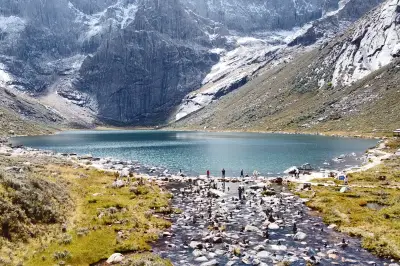
After spending some time at Long Lake, we continued by bus to the next stop—Five Color Pond. From the drop-off point, we had to climb over several large rocks to reach the pond.
Songping Valley's Five Color Pond is a patch of colorful water, also called Love Lake. The lake water is exceptionally clear, like a mirror, transparent and pure.
After ascending from Five Color Pond, we took the bus to Ink Lake.
Ink Lake was formed by rock fractures and subsidence accumulating water, as well as mountain collapse blocking water flow. The water settles on dark green rocks, deep and bottomless. The color is as deep as blue ink, hence the name. Standing peaks, leafy trees, green pines, and mixed flowers and plants are reflected in the lake. The interaction between water and surroundings makes the water deep blue like ink, as if a pool of ink was spilled. Under sunlight, Ink Lake sparkles with spiritual light.
Standing by Ink Lake, looking into the distance, golden sunlight spreads over the water, a breeze stirs up sparkling ripples. Steep peaks, dense forests, mountains, water, and woods form a light ink painting in the quietness.
We took some photos at Ink Lake, then took the sightseeing bus back to the entrance. White Stone Lake is right next to the entrance.
White Stone Lake is the largest lake in the Diexi·Songping Valley Scenic Area, also called Gongpeng Lake or Wa'erpu Lake, named after a mysterious white stone by the lake. The lake is shaped like a flat sickle, with the tip being deepest, the green between the cliffs breathtaking; the lake surface reflects blue sky, white clouds, green mountains, and trees.
Perhaps due to insufficient rainfall this year, the scenery of the entire Songping Valley scenic area was not as good as expected. After spending some time at White Stone Lake, we took the bus back to the hotel.
Day 9
Our original itinerary also included Bipeng Valley and Wulong Scenic Area in Chongqing, but some changes occurred during the trip, forcing us to terminate the itinerary early. We canceled the pre-booked subsequent train tickets and hotels. In the morning, we took a bus to Chengdu Chadianzi Bus Station, then transferred to the subway to Chengdu Tianfu International Airport, and boarded a 17:20 flight back to Tianjin.
October 2023